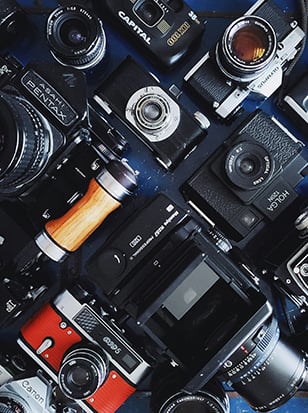

Welcome to our guide to the best cameras for street photography! With these slim, agile cameras, you'll be able to capture the fleeting moments of urban life as they happen. Street photography is a pacy and exciting pursuit – addictive once you get into it! If you invest in a camera that can keep up with the action, it really can pay dividends in terms of the images you come away with.
Many photographers favour compact cameras for street photography – compact in this case meaning fixed-lens cameras. Ideally, you want one with slim dimensions and a nice, sharp prime lens on the front. Accordingly, most of the cameras on our list do indeed conform to those criteria, but we have also included a budget-friendly interchangeable-lens option for those who want something less specialised.
You can scroll to the bottom of this page to see the criteria we’ve used when making our picks, and we also have a dedicated guide to the best compact cameras that includes lots of street-friendly models.
What's coming up:
Best camera for street photography overall: Fujifilm X100VI
Best X100VI alternative: Ricoh GR IV
Best Leica camera for street photography: Leica Q3 43
Best budget camera for street photography: Panasonic Lumix TZ99
Best mirrorless camera for street photography: Fujifilm X-M5
Best medium format camera for street photography: Fujifilm GFX100RF
Best camera for street photography overall:
|
Pros:
Cons:
|
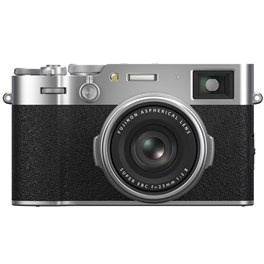
Sensor: 40.2MP APS-C X-Trans CMOS 5 HR Lens: Fixed Fujinon 23mm f2 (35mm full-frame equivalent) Image Stabilisation: 6-stop In-Body Image Stabilisation (IBIS) Autofocus: 425-point Intelligent Hybrid AF with AI subject detection Video: 6.2K/30p internal recording |
The Fujifilm X100VI is the sixth iteration of a series that has long been considered the best of the best for street photography, offering a slew of upgrades. We have a versatile 40MP sensor, some of Fujifilm's best AF performance and finally, in-body image stabilisation.
The model retains the same classic Fujifilm dial-based control system as the previous entries in the series, giving that throwback to the days of analogue shooting. As with all Fujifilm cameras, the X100VI produces images with beautiful colours straight out of camera, minimising the need for too much time editing and allowing you to spend more time shooting. Of course, you can take it a step further by experimenting with Fujifilm's hugely popular Film Simulation modes.
More on that sensor. It is the same 40.2MP X-Trans 5 sensor as used in the X-T5 and X-H2 and is coupled with the X-Processor 5 which together provide excellent speed and precision. This upgrade also provides a boost to video capabilities allowing you to shoot up to 6.2K video footage. The full list of upgrades is dizzying, to say the least, but all in all, the improvements further show how well this camera is suited to street photography, and now, videography too.
Best X100VI alternative:

|
Pros:
Cons:
|
Sensor: 25.7MP APS-C BSI CMOS sensor Lens: 28mm f2.8 (full-frame equivalent) fixed lens Stabilisation: 5-axis, 6-stop Shake Reduction system Display: 3.0" 1.04m-dot touchscreen LCD Storage: 53GB built-in memory + microSD card slot |
Ricoh’s GR cameras may not be quite as TikTok-famous as the X100VI and its predecessors. However, they are brilliant cameras that serve a very similar purpose, and if you’re looking for something a little more affordable and easier to find than the X100VI, the new Ricoh GR IV should be high on your wishlist.
With a fixed 28mm lens and a high-quality APS-C sensor, the Ricoh GR IV provides a perfect platform for street photography. It’s slim enough to slip into a pocket or small bag, or hang on a wrist strap, and it’s a fast camera too, able to start up in fractions of a second. The 5-axis stabilisation system makes it easier to get sharp shots at slower shutter speeds, and there’s also an unusual feature we really love — 53GB of internal storage! This means that even if you forget, lose or damage your microSD card, you can still keep shooting with the GR IV.
Best Leica camera for street photography:

|
Pros:
Cons:
|
Sensor: 60MP full-frame BSI CMOS sensor Lens: APO-Summicron 43mm f2 ASPH Lens Video: 8K video recording capability Connectivity: USB-C, HDMI, Bluetooth, Wi-Fi Viewfinder: OLED electronic viewfinder with high resolution |
The name “Leica” is a watchword in street photography, and if you want a street-shooting camera from the best in the business, our recommendation is the utterly fabulous Leica Q3 43. It’s a compact camera similar to the X100VI and GR IV, only instead of an APS-C sensor it offers full-frame, and its lens is a narrower 43mm optic. This provides a naturalistic field of view, similar to that of the human eye, giving you a little less of the wider scene but making it easier to hone in on specific elements.
The 60MP sensor delivers utterly dazzling images, with that renowned Leica colour science producing images with that unmistakable Leica “look”. It’s also a triple-resolution sensor, meaning you can shoot at 36MP or 18MP if you want to save on card space. In terms of handling and ergonomics, the Q3 43 is a dream, with an all-metal body built to Leica’s exacting engineering standards, as well as a beautiful high-resolution OLED viewfinder for composition.
Best budget camera for street photography:

|
Pros:
Cons:
|
Sensor: 20.3MP 1/2.3-inch MOS Processor: Venus Engine ISO Range: 80-3200 Autofocus: Depth from Defocus (DFD) Connectivity: Wi-Fi and Bluetooth |
If you're looking to get started with street photography on a budget, we can happily recommend the Panasonic Lumix TZ99. A slim, travel-friendly compact that boasts a powerful 30x zoom, the Lumix TZ99 is incredibly versatile for such a portable camera. Its lens spans an equivalent focal range from wide 24mm to super-telephoto 720mm, meaning you have enormous flexibility when it comes to composing your shots, at any distance.
It's worth noting that a few necessary cuts have been made to ensure that this camera is able to be as small, affordable and portable as it is. There's no viewfinder, so you'll be composing with the tiltable LCD monitor, and the maximum aperture only extends to F3.3 at the wide end and F6.4. It's still perfectly possible to achieve shallow depth of field; you'll just need to get as close to your subjects as you can. Overall though, this is an ideal take-everywhere camera for anyone who wants to get started with street photography on a budget.
Best mirrorless camera for street photography:

|
Pros:
Cons:
|
Sensor: 26.1MP X-Trans BSI CMOS 4 Processor: X-Processor 5 ISO Range: 160-12,800 Autofocus: 425-point autofocus system with subject detection Connectivity: Wi-Fi and Bluetooth |
If you prefer the idea of having a mirrorless system camera with interchangeable lenses for street photography, then our recommendation is the Fujifilm X-M5. This super-slim shooter is made for unobtrusive photogaphy, and pairs briliantly with the high-quality range of X-mount lenses to deliver outstanding image quality. As is always the case with Fujifilm's cameras, you can take advantage of the full range of Film Simulation modes to produce images with distinctive, analogue-style looks. Or, if you prefer, shoot in raw and take complete control over your images.
The 26.1MP X-Trans BSI CMOS 4 produces rich, vivid imagery full of colour and detail. The X-M5 is quite a speedster, too, capable of capturing images at burst rates of up to 20fps when using the electronic shutter. Its 425-point autofocus system benefits from the latest advancements in AI-powered subject detection. There's no viewfinder, so you'll have to compose with the LCD screen – a good tip is to angle it upwards and use it like a wasit-level finder. Otherwise, this capable little mirrorless model ticks every box for street photography
Best medium format camera for street photography:

|
Pros:
Cons:
|
Sensor: 102MP 43.8 x 32.9mm BSI CMOS II medium format sensor Lens: Built-in FUJINON GF 35mm f4 (28mm equivalent) Video: DCI 4K30p with external ProRes recording Display: 3.2" 2.1m-dot 3-way tilting touchscreen Features: Digital teleconverter, internal ND filter, leaf shutter |
Street photography on medium format?! The Fujifilm GFX100RF makes it not just possible, but spectacular. Cramming a large sensor into a body that’s really not that much bigger than that of the X100VI, this incredible camera delivers 100MP image quality in a format that’s suited to the fast pace of street photography.
The sensor is paired with a 35mm (28mm equivalent) F4 lens that’s sumptuously crisp and sharp, making the most of all those pixels. And having all that resolution to spare means you can make use of powerful digital crop modes to simulate longer focal lengths, with 45mm, 63mm and 80mm equivalents available. Even cutting into the image significantly, you’ve got so many pixels that you’ll still get a high-quality image, and if you shoot in RAW, the entire sensor readout will be recorded anyway — so you can always “de-crop” the image if you change your mind later. Though if you do shoot in this format, be prepared for your memory cards to fill up quickly.
With superb ergonomics, the Fujifilm GFX100RF achieves its mission of bringing an X100-style experience to medium format. A spectacular camera.
FAQs
What kind of camera should I buy for street photography?
Look for a camera that's compact and lightweight, with good autofocus, low-light performance, and fast burst shooting. A mirrorless camera or a high-end compact camera would be a good choice.
Do I need to buy an expensive camera for street photography?
No, you don't need an expensive camera for street photography. A good camera with a fixed lens and manual controls is all you need. The important thing is to master the art of seeing and capturing interesting moments.
Which lens is best for street photography?
A prime lens with a wide aperture (such as f1.8 or f2) is ideal for street photography. A 35mm or 50mm lens is popular among street photographers because they're versatile and allow you to capture a wide range of subjects.
Should I shoot in manual mode for street photography?
Shooting in manual mode gives you full control over your camera settings, which is important in street photography. However, it can be challenging to get the settings right in a fast-moving environment. If you're new to photography, you may want to start with aperture priority mode and then gradually move to manual mode.
Do I need a tripod for street photography?
No, you don't need a tripod for street photography. In fact, it can be a hindrance when you need to move quickly to capture a fleeting moment. A handheld camera or a camera with in-body image stabilisation should be sufficient.
Should I shoot in RAW or JPEG for street photography?
Shooting in RAW format gives you more control over your post-processing, allowing you to adjust the exposure, colour, and sharpness of your images without losing quality. However, it also requires more storage space and processing power. Shooting in JPEG format is more convenient if you don't plan to do a lot of post-processing.
How important is the camera's autofocus system for street photography?
The autofocus system is crucial for street photography, as you need to be able to focus quickly and accurately on your subject. Look for a camera with a fast and reliable autofocus system, preferably with a high number of autofocus points and face detection.
How to choose the best camera for street photography
The definition of street photography is quite broad, but at heart, it’s about documenting public spaces and the people who live and work in them. Any camera can be a street camera in the right hands, but at the same time, there are a few ways you can make the discipline easier and more accessible by focusing on the kinds of features that are best suited for the particular art of street shooting.
Here are the main criteria we’ve kept in mind when picking the best camera for street photography:
Speed: Street is all about capturing fleeting moments, and the thing about fleeting moments is… well, let’s not get redundant. Suffice to say, a camera with fast autofocus and solid burst speeds is really going to help you up your hit rate when street shooting.
Portable dimensions: A good street camera is ideally going to be unobtrusive. You want to see people behaving naturalistically, as they would if you weren’t there, so it helps to be able to blend into the background. Despite what some photographers may think, a massive SLR with a battery grip and a lens longer than your arm does not blend into the background. Thinking small is a good idea.
Tilting/articulating LCD screen: This isn’t completely essential. Many street shooters prefer a viewfinder, and that’s fine too. However, if you want to shoot unobserved, a great way to do so is to avoid bringing the camera up to your eye — and having a tilting or (even better) a fully articulating LCD screen is an excellent way to compose your shots while keeping the camera around waist level.
Affordability: Street photography is a fun, exciting discipline that requires no expensive lighting or other accessories. It’s just about you, the camera and the environment – as such, we’ve made an effort to keep this list accessible by including plenty of affordable cameras, as well as more expensive options for those who can stretch their budget.
Browse our full range of cameras
How do we decide?
Our in-house photography specialists, store staff, and industry partners work together to review our buying guides and advice articles. We also monitor emerging trends and listen closely to customer feedback, ensuring our recommendations stay current and relevant to what photographers and filmmakers are actually looking for.
By carefully curating the products we recommend, our guides are designed to offer clear, trustworthy advice that helps customers choose the right kit with confidence.
If you would like further advice, our contact centre team are here to help. You can also reach us via email or social media. And remember, if you purchase based on our recommendations, your order is covered by our full returns policy.
The Wex Blog

Sign up for our newsletter today!
- Subscribe for exclusive discounts and special offers
- Receive our monthly content roundups
- Get the latest news and know-how from our experts