
Our guide to ten affordable lenses for Nikon users is designed for any Nikon user who’s feeling a little strapped. With costs rising across the board, it can be hard to justify spending money on hobbies, or even on our professional equipment! But that’s not to say we should give up, as there are plenty of brilliant Nikon lenses, for both mirrorless and DSLR cameras, that can be picked up for an affordable price.
This is a selection of F-mount and Z-mount lenses that won’t break the bank. We’ve included a range of primes and zooms in a variety of focal lengths, and while there are plenty made by Nikon themselves, we’ve also included lens options from third-party manufacturers, as this is often a great way to make savings. We’ve also made sure there’s a mix of both APS-C (DX) and full-frame (FX) lenses: remember to check which type your camera is before buying.
So, let’s get to our top ten affordable Nikon lenses…
10 Affordable Nikon Lenses

|
Pros:
Cons:
|
Focal Length: 50 mm Aperture Range: f1.8-22 Minimum Focus Distance: 0.45 m Magnification: 0.15× (1:6.67) Filter Thread: 52 mm |
In any conversation about affordable lenses, someone is always going to bring up the good old nifty fifty. This term refers to the kind of affordable, wide-aperture 50mm lens that tends to be available for most systems – and Nikon’s F-mount DSLRs are no exception. The Nikon 50mm f1.8 D AF is an older lens, and fairly simple, meaning you don’t get fancy new features like optical stabilisation – but what you do get is a sharp, lightweight and fast lens that delivers excellent images for very little outlay.
There’s a reason beginners often get recommended nifty fifties, and it’s not just the cost. The standard focal length provides a naturalistic perspective that’s intuitive to shoot with because it’s roughly the same field of view as a human eye. Also, if you’re using a more affordable APS-C DSLR, then it works out to an equivalent of 75mm, which means you’ve got yourself a cheap-as-chips portrait lens. Having f1.8 will give you significantly more latitude in low light than you’ll get from any kit zoom, too. Plus, learning to use a prime, and to move your feet rather than your zoom ring when you need to get closer to a subject, is a time-honoured way of improving your composition skills.

|
Pros:
Cons:
|
Focal Length: 50 mm Aperture Range: f2.5–22 Diaphragm: 12-blade Minimum Focus Distance: 1.1 ft (≈0.33 m) Tilt Range: up to 30° in any direction |
The Lensbaby Spark 2.0 is a wonderfully affordable way to do something a little different with your Nikon DSLR. Rather than worrying about tack-sharpness, the Lensbaby embraces optical imperfection and encourages users to push their creativity, resulting in distinctive and stylish images. It works via a tilt-shift mechanism that allows you to physically manipulate the front element of the lens to create a ‘sweet spot’ of sharp focus that’s surrounded by a stylised blurred background. This is great for creating dreamlike portraits, but also has many other uses – try it in still-life or even landscape photography and see what kind of results you get. The whole point is experimentation!
Also, the Lensbaby Spark 2.0 accepts filters via its 46mm filter thread, so you can push the boat out even further by adding more in-camera effects. In fact, Lensbaby makes its own 46mm filter kit that lets you experiment with different focusing distances.
|
Pros:
Cons:
|
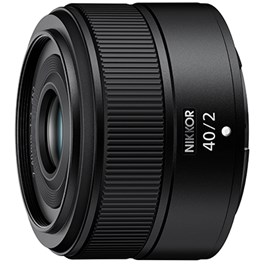
Focal Length: 40 mm Aperture Range: f2-16 Minimum Focus Distance: 29 cm Magnification: 0.17× (1:5.9) Aperture Blades: 9 (rounded) |
In case you assumed all Z-mount lenses were going to be expensive, here’s a lovely affordable prime for Nikon’s mirrorless system. The Nikon Z 40mm f2 sits in a focal-length sweet spot that’s great for street photography, and boasts a lightweight body that’s optimal for travel (just be careful in the rain – it’s not weather-sealed). Its stepping motor autofocus is nice and fast, and f/2 is wide enough to throw out the background when you need to. It’s a budget-friendly lens for doing a bit of everything – great for exploring a city on holiday when you don’t want to be swapping lenses too often.
It can be mounted on Nikon’s DX-format Z-mount cameras like the Z30 and Z fc, and there it will provide an equivalent focal length of 60mm – still nice and natural-looking. The focusing action of the lens is ultra-quiet, too, so it’s a great one for video.

|
Pros:
Cons:
|
Focal Length: 28 mm Aperture: f2.8-f16 Minimum Focus Distance / Reproduction Ratio: 0.19 m / 0.63 ft; 0.2× Construction: 9 elements in 8 groups (2 aspherical) Weight: Approximately 155 g |
Sticking with Z-mount for the moment, the Nikon Z 28mm f2.8 is one of the lightest primes you can buy for the system, and offers a versatile 28mm focal length (bumped up to 42mm if used with a DX-format camera). It can focus as close as 19cm from the subject, meaning you can make the most of that wider field of view and really fill the frame. Optics are generally pretty good, rendering crisp colours and delightful sharpness. It focuses quickly and silently too, which will be good news for the videographers who may have already been eyeing it up for its video-friendly 28mm focal length.
There aren’t many physical control buttons on the lens, and some may find themselves wishing for an AF/MF switch; however, Nikon did manage to find room for a control ring. It’s worth being aware that there’s no optical Vibration Reduction stabilisation on this lens.

|
Pros:
Cons:
|
Focal Length: 40mm Aperture: f2.8-22 Minimum Focus Distance / Magnification: 0.163 m / 1:1 reproduction (life-size) Autofocus: Silent Wave Motor (SWM) Weight: Approximately 235g |
It’s remarkable how cheap this DSLR lens is considering how well optimised it has been for close-up shooters. The close focusing distance is hugely impressive, with a minimum focusing distance of just 16.3cm (at that kind of range, you have to be careful not to get in your own light!). The lens offers a true macro magnification ratio of 1:1, meaning subjects are rendered life-size on the sensor, and it has a handy manual-priority autofocus mode that makes it easy to switch from auto to manual mode for fine-tune adjustments to focusing.
This is a DX-format lens only, meaning it’s built for APS-C DSLRs (on which it delivers an equivalent focal length of 60mm). While it works well enough as a standard prime and can certainly handle general-purpose photography, if you have no interest in close-ups then there are probably other lenses that will offer more value for money. For those who want to shoot the smallest details on a budget, however, this lens is practically unparalleled.

|
Pros:
Cons:
|
Focal Length: 12-28 mm (18-42 mm full-frame equivalent) Aperture: f3.5-5.6 Power Zoom & Stabilisation: Built-in Power Zoom (PZ) and Vibration Reduction (VR) Minimum Focus Distance: 0.19 m Weight: 205 g |
Many APS-C Nikon mirrorless cameras are popular for vlogging, and Nikon has catered to this section of the user base with some brilliant wide lenses. One of the best is the 12-28mm f3.5-5.6 DX PZ VR, a capable and powerful short zoom lens that boasts video-friendly features like a motorised Power Zoom mechanism to ensure smooth zooming transitions. This mechanism can also be controlled via buttons on the camera, a remote control or the SnapBridge app, allowing you to be totally hands-off if you need to.
The 12-28mm f3.5-5.6 DX PZ VR also has an impressive 0.19m close-focusing distance, letting you get up close to your subjects if so desired. Its 4.5 stops of built-in Vibration Reduction also helps keep shots stable, which is great for vloggers and photographers alike.
All this and we haven’t even talked about the image quality! It is, of course, great, with a construction of 12 elements in 11 groups, including one ED and one aspherical element, ensuring sharp and detailed imagery right the way through the zoom range.

|
Pros:
Cons:
|
Focal Length: 16-50 mm (24-75 mm equivalent) Aperture: f3.5-6.3 (max), f16 (min) Minimum Focus Distance / Magnification: 0.20 m / 0.2× Weight: 135 g |
There aren’t all that many lenses optimised specifically for the DX-format cameras in the Z family, so if you’re using one, this is definitely a lens worth considering. Covering an equivalent zoom range of 24-75mm, it’s very much an all-purpose lens, but the pancake design makes it much more portable than the professional workhorses that bear a similar focal range. Granted, one thing you do have to get used to is how significantly the aperture drops when you zoom in – f/6.3 can be quite restrictive. But on the plus side, the built-in Vibration Reduction is a huge help with Nikon’s APS-C Z-mount cameras, which don’t have an in-body stabilisation system of their own.
The optical quality impresses here, thanks to a construction of nine elements in seven groups, including extra-low dispersion glass and aspherical elements for control of aberrations and distortion.
|
Pros:
Cons:
|
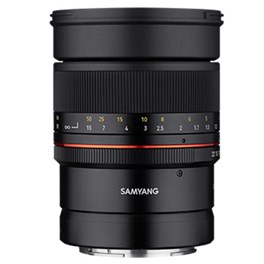
Focal Length: 85 mm Aperture: f1.4–22 Optical Design & Coating: 9 elements in 7 groups, includes 1 hybrid aspherical element; Ultra Multi-Coating (UMC) Minimum Focus Distance / Magnification: 1.1 m / 0.09× (1:11) Weight: 740 g |
Looking to shoot portraits on Nikon Z cameras, but put off by the cost of the lenses? The Samyang MF 85mm f1.4 Lens for Nikon Z should be your first port of call – it’s an immensely budget-friendly lens sitting in the portraiture sweet spot of 85mm. It’s a short telephoto, narrow enough to flatter subjects but still get in a bit of nicely blurred background, aided by the f/1.4 maximum aperture. The quality of the background bokeh is excellent too – this lens has been carefully optimised for pitch-perfect portraiture.
There are a few compromises to be made – possibly the most significant is that it’s a manual-focus only lens. There’s no electronic communication with the camera at all in fact, so you also can’t change the aperture using the camera’s settings, and will need to use the lens ring (aperture settings also won’t be recorded in image metadata). Fortunately, the manual control experience of using this lens is sublime, wonderfully intuitive, and the savings you make compared to conventional portrait lenses are just unreal.

|
Pros:
Cons:
|
Focal Length (35 mm equivalent): approx. 35 mm Aperture: f1.4–16 Minimum Focus Distance: 20 cm Optical Design: 8 elements in 6 groups (1 low dispersion + 3 high index) Focus Type: Manual focus |
If you’ve never experimented with a manual focus lens before, going for an affordable one is a good way to get a feel for it. TTArtisan offers a number of options for Nikon’s Z-mount, and one of our favourites is the 23mm F1.4. It’s designed for APS-C (DX-format) cameras like the Nikon Z30 and Z50 II, though in its vintage retro charm, particularly in the silver version, the camera it perhaps pairs with most pleasingly is the Nikon Z fc.
Providing an equivalent focal length of 35mm in full-frame terms, the TTArtisan 23mm f1.4 is a fun option for street photography. The focusing action is fast and smooth, with a good level of weight and resistance to the focusing ring, and it produces beautiful bokeh in the defocused areas of images thanks to a ten-blade aperture.
This isn’t a lens for those who are obsessed with optical perfection (though it does punch above its weight, sharpness-wise). It’s a lens for those who want a more tactile photographic experience, a way of producing images that feels a little more hands-on.
|
Pros:
Cons:
|
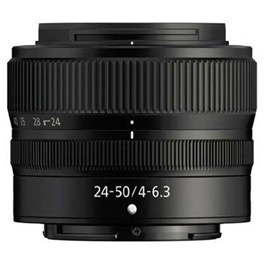
Focal Length: 24-50mm Aperture: f4-6.3 Minimum Focus Distance: 35cm Optics: 11 elements in 10 groups |
This is something of an unusual zoom, covering a fairly short range. It is, however, incredibly light – one of the lightest full-frame zoom lenses on the market, in fact, weighing in at less than 200g. This makes it a handy one to pick up for travel or day-to-day photography when you don’t want too much bulk on your camera, and it produces wonderfully crisp and sharp images across its zoom range.
Nikon has engineered this lens specifically to minimise focus breathing, making it a good option for video. It isn’t stabilised, however, so you will need to rely on the IBIS of Nikon’s Z-mount bodies, or possibly invest in a gimbal. Also, once again you’re working with quite a narrow aperture at the narrow end of the zoom, so that will affect how you’re able to use the lens once the light gets low.
FAQs
What is the difference between Nikon DX and FX lenses?
Nikon DX lenses are designed for APS-C sensor cameras, providing a smaller image circle. FX lenses are for full-frame cameras, offering a larger image circle and better low-light performance.
Can I use Nikon DX lenses on FX cameras?
Yes, you can use DX lenses on FX cameras, but there will be a crop factor. FX cameras can automatically detect DX lenses and adjust settings accordingly.
What is the best Nikon lens for portrait photography?
Nikon’s 85mm and 50mm lens offerings are popular choices for portrait photography due to their excellent bokeh and sharpness.
What does the "G" mean in Nikon lens names (e.g., Nikon AF-S 50mm f1.8G)?
The "G" indicates a lens with no aperture ring. Aperture settings are controlled electronically through the camera body.
What is the difference between VR and VR II in Nikon lenses?
VR II typically denotes a second-generation vibration reduction system, offering improved stabilisation and better performance in low light.
Can I use Nikon DSLR lenses on Nikon mirrorless cameras?
Yes, you can use Nikon F-mount DSLR lenses on Nikon mirrorless cameras using the appropriate adapter, which allows you to maintain autofocus and aperture control.
How do we decide?
Our in-house photography specialists, store staff, and industry partners work together to review our buying guides and advice articles. We also monitor emerging trends and listen closely to customer feedback, ensuring our recommendations stay current and relevant to what photographers and filmmakers are actually looking for.
By carefully curating the products we recommend, our guides are designed to offer clear, trustworthy advice that helps customers choose the right kit with confidence.
If you would like further advice, our contact centre team are here to help. You can also reach us via email or social media. And remember, if you purchase based on our recommendations, your order is covered by our full returns policy.
The Wex Blog



Sign up for our newsletter today!
- Subscribe for exclusive discounts and special offers
- Receive our monthly content roundups
- Get the latest news and know-how from our experts