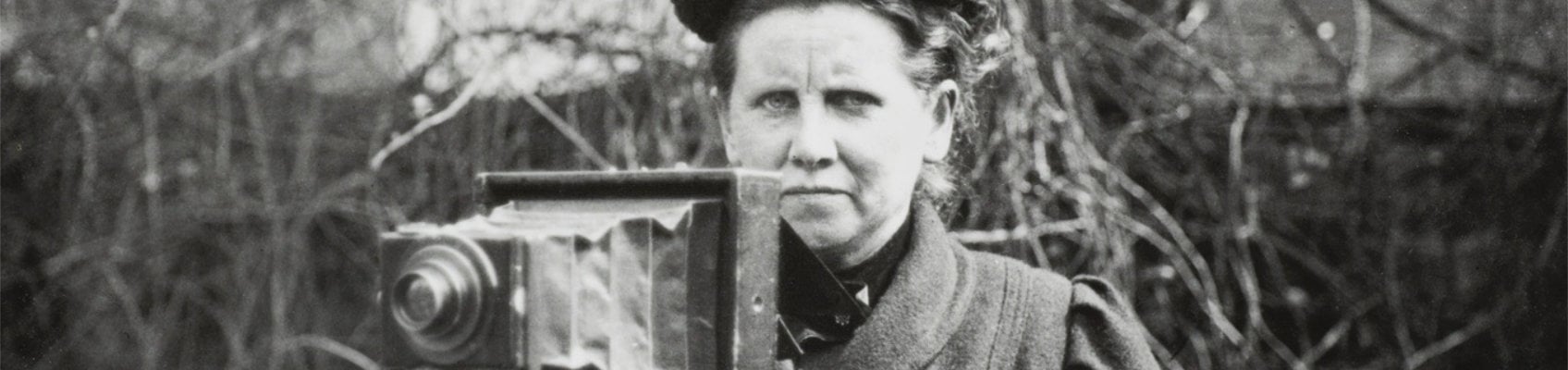
History has often done a poor job of recording the achievements of women – and photographic history is no exception. When it comes to photographic firsts, the names most familiar to us are, predictably, men. William Henry Fox Talbot. Louis Daguerre. Joseph Nicéphore Niépce.
This isn’t to say that those men don’t deserve their accolades. But some light too deserves shining on the women of photography’s history. Those who got there first, whether being some of the first women to take a photograph at all, or the first women to bravely carry a camera into a war.
The reality is that there are more such women than we could possibly include in an article like this. So, here are just a few of photography’s female pioneers…
1839: Sarah Anne Bright and Constance Fox Talbot
Who was the first woman to capture a photograph? We can’t know for sure, of course. But there are two women in particular who have strong claims to the title.
The first is Sarah Anne Bright (1793–1866). An artist born in Bristol, Bright’s importance to the world of photography was unknown for more than a century after her death. It wasn’t until 2008, when a photogram print of unknown provenance, titled “The Quillan Leaf”, appeared at an auction at Sotheby’s. Photographic expert Larry Schaaf did some careful detective work, and eventually figured out that the initials on the print, initially thought to read “H.B.”, in fact read “S.A.B.”, and matched Sarah Anne Bright’s handwriting.
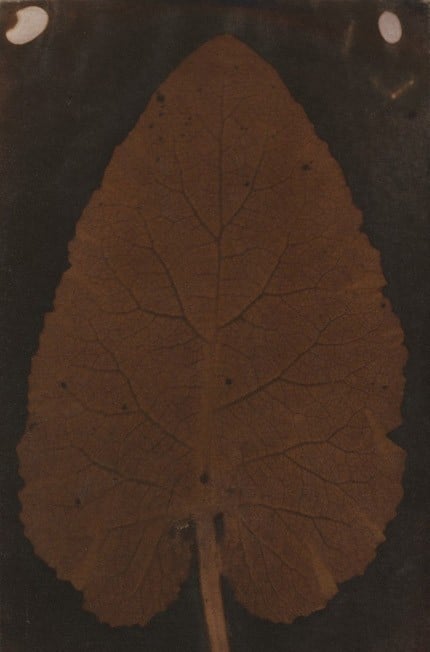
With the print conclusively dated to 1839, this made Sarah Anne Bright quite possibly the first woman to create a photograph. However, there is a possibility she was pipped to the post by Constance Fox Talbot, wife to Henry, who captured an image of four lines of a Thomas Moore poem by shining light through the original manuscript, experimenting with the negative-positive process of photography to make a calotype.
This too was dated to 1839, meaning that one of either Bright or Fox Talbot is almost certainly the first woman to capture an image that we would today define as a photograph.
1843: Anna Atkins
Anna Atkins (1799-1871) was also connected to the Fox Talbots, being a friend of Henry’s. As such, she had access to photographic materials and processes much earlier than most women did. She is not just the first woman, but the first person, to publish a book illustrated with photographic images – the catchily titled Photographs of British Algae: Cyanotype Impressions.
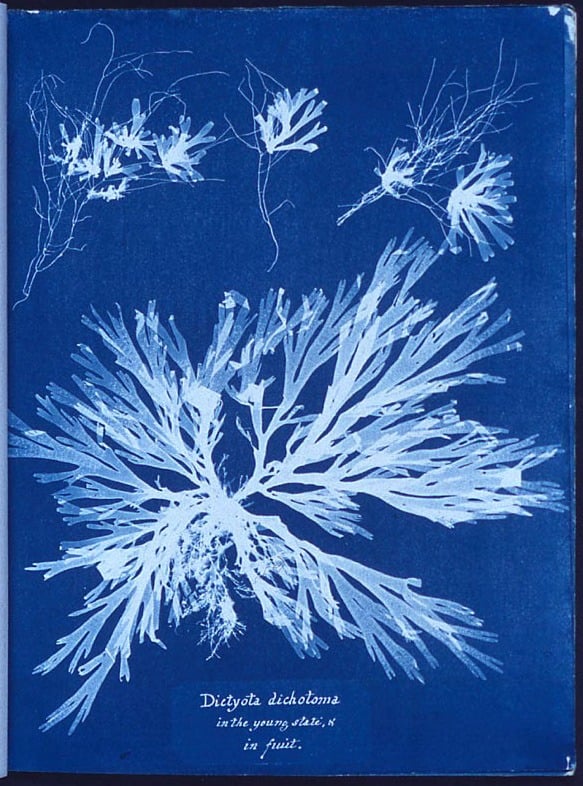
Atkins possibly has another claim to fame, though one that can’t be verified. Sarah Anne Bright and Constance Fox Talbot both produced photographs using camera-less processes on light-sensitive paper. Atkins, however, was known to have held a camera as early as 1841, and may well be the first woman ever to capture a photograph with one. Sadly, if she was, none of those photographs have survived.
1903: Christina Broom
Necessity, as they say, is the mother of invention. In 1904, Christina Broom (1862-1939) needed some money, badly. A string of failed businesses in her family, plus her husband Albert’s leg injury from a cricket match, had left the family struggling to make ends meet. Christina, an enterprising sort, resolved to pick up a new-fangled box camera, teach herself how it worked, and start selling postcards at a stall she set up near Buckingham Palace.
To say she was successful is to undersell her. At the peak of the stall’s popularity, Broom was printing more than a thousand photographs a night. The army’s nearby Household Division noticed her talent and appointed her as its official photographer; she went on to photograph important events throughout the first half of the twentieth century, including suffragette marches.
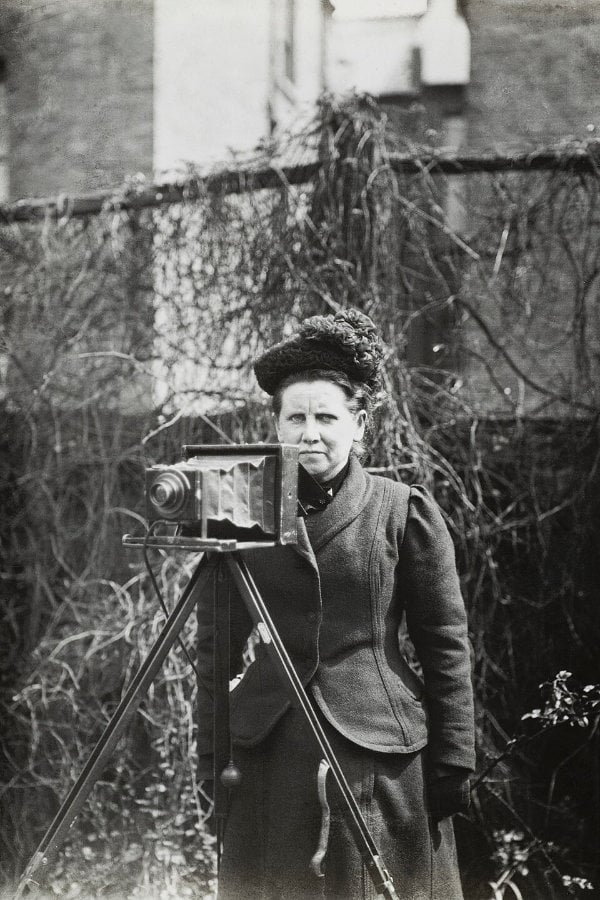
This made Christina Broom, arguably, the UK’s first ever female press photographer. All from a stall set up to sell postcards.
1920s: Elise Forrest Harleston
Putting milestones on top of milestones, Elise Forrest Harleston (1891-1970) was quite possibly one of the first black female photographers in the United States. In 1919, after having worked as a teacher and a seamstress, she enrolled at the E. Brunel School of Photography in New York, one of only two black people to do so, and the only black woman.
She would go on to open her own studio in Charleston, South Carolina, and become an important figure in the “New Negro” art movement pushing back against black stereotypes.
1928: Margaret Bourke-White
An entire article of this length could have been filled with the exploits and achievements of the incredible Margaret Bourke-White (1904-1971). She opened her first photographic studio in Cleveland, Ohio, in 1928, but in 1929 she accepted a job as staff photographer for the new fledgling Fortune magazine – and from there, she blossomed.
She became the first Western photographer permitted to travel into and photograph the Soviet Union in 1930. When the Second World War broke out, she became one of the first female photographers to work in combat zones – possibly the first – and was the only foreign photographer present in Moscow when the Germans invaded. Later, she would travel through Germany as it collapsed into defeat, and would photograph the liberated Buchenwald concentration camp.
And her seminal work didn’t end after the war, travelling to India in the 1940s, where she captured an iconic image of Gandhi, and documenting the partition of India and Pakistan. Though her career was ultimately cut short by Parkinson’s disease, Bourke-White had already cemented her legacy as one of photography’s all-time greats.
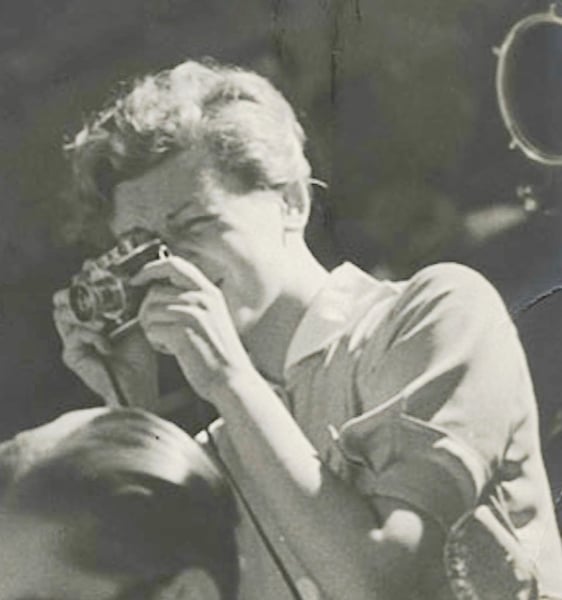
1937: Gerda Taro
Not all milestones are happy ones. Gerda Taro (1910-1937), a fearless photographer and committed anti-fascist who was born in Germany but fled shortly after Hitler came to power, became the first woman photojournalist to die on the front lines of a conflict when she was killed by a tank while covering the Spanish Civil War.
Though Gerda Taro had a short career, it was impactful. Together with Robert Capa – with whom she travelled and worked closely – she developed and codified what we now think of as modern war photography. Intimate, vicarious images that place the viewer at the heart of the conflict, in the eyes of those fighting it.
1945: Marion Carpenter
Pioneering women often have to put up a share of… let’s be polite and call it “nonsense” from the men around them. Marion Carpenter (1920–2002) spent much of the immediate post-war period travelling with President Truman as the first female national press photographer to cover the White House, and had to put up with commonly being referred to by the men around her as “the camera girl”. She also, despite being Truman’s official photographer and a member of the White House Photographers Association, was not allowed at the President’s annual dinners, as women were barred from attending.
Despite it all, she got on with the job. Sadly, it wasn’t until after her death that she was rightly celebrated as a true trailblazer for women photographers.
1991: Annie Leibovitz
Finally, a different kind of milestone – one that arguably says more about the institution than the woman. Those who are familiar with the work of the great Annie Leibovitz (b.1949) will no doubt have already clocked that she was quite well established by 1991. She’d already worked for Rolling Stone, and had captured the final professional photograph of John Lennon on what would be the day of his murder.
However, in 1991, Leibovitz became the first woman to have a feature exhibition at the Washington National Portrait Gallery, with a gallery of her photographs from 1970 onwards. And it’s grimly amazing that even as late as 1991, a century and a half after a woman first picked up a camera, a major national gallery could be just getting around to hosting a major exhibition by a woman for the first time.
Of course these women comprise a mere handful of the trailblazers we could have included from photography’s storied two-century history. For as long as there have been photographs to take, there have been women taking them. Some fighting for their place at the table, and others simply expressing their passion and creativity.
About the Author
Jon Stapley is a London-based freelance writer and journalist who covers photography, art and technology. When not writing about cameras, Jon is a keen photographer who captures the world using his Olympus XA2. His creativity extends to works of fiction and other creative writing, all of which can be found on his website www.jonstapley.com
The Wex Blog
Sign up for our newsletter today!
- Subscribe for exclusive discounts and special offers
- Receive our monthly content roundups
- Get the latest news and know-how from our experts