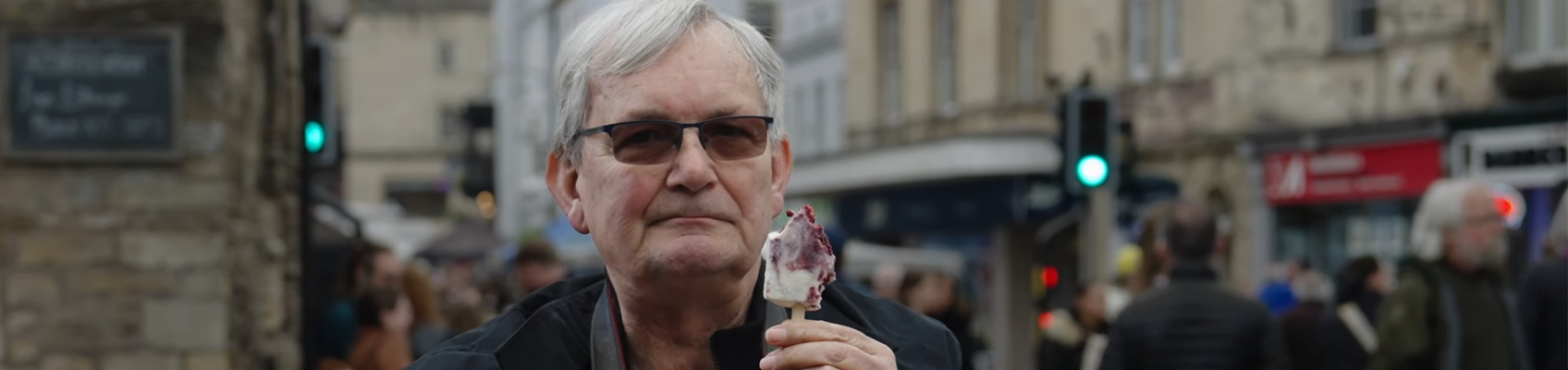
I first met Martin in 2017, after sending him an email that could only be described as financially barren and shamelessly earnest. I told him I had £500, almost nothing to tempt him with, and only the rather naïve ambition of hearing him speak. I had a venue at my new place of work: an unpainted retail unit with the lingering charm of wet plaster. Maximum capacity: 50. Standing room only.
Martin said yes.
Almost nine years later, I find myself heartbroken to read of the loss of not just a cultural giant whose satire reshaped how we see Western society, but a friend; one who understood that kindness, too, can be a radical act, and that generosity and humour are not opposites but long-time collaborators.
We met at his exhibition of remote Scottish post boxes — classic Parr; a wry meditation on the ordinary elevated to the quietly sublime. I had expected a formal introduction in a room thick with important people and even more important opinions. What unfolded instead was something startlingly intimate. Only later did I understand this was simply Martin’s default setting: he moved through the world creating pockets of homeliness, making even the most unassuming moments feel gently lit from within.
I still inwardly wince at the memory of my then-boss surveying a table piled with more than a hundred books and asking, with brisk authority, “And which one is yours?”
Martin allowed me the pleasure of replying, “All of them!”
There are so many stories about Martin that linger in my mind with comic tenderness. I could begin with the six whole cakes I bought for our first piece of work together, an act of sheer panic masquerading as hospitality, the desperate logic of someone trying far too hard to impress a man who, as it turned out, was utterly unimpressible in the most grounded, generous sense.
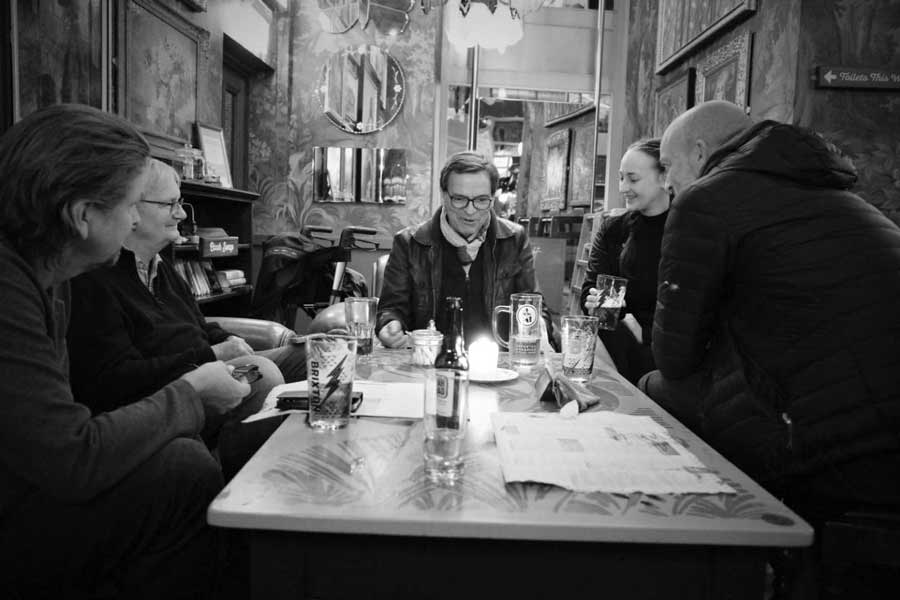
Or the evening when photographer Matt Stuart and I, fuelled by the confidence only wine and bad Indian food can provide, attempted to coax out of Martin the true identity of Banksy. Martin remained amused, evasive, and entirely in control.
And then there were the quieter moments: an evening spent eating some of the best food of my life cooked by his wife, Susie, and the Foundation family, where laughter moved easily and the conversation felt as textured and nourishing as the meal itself. Those were the moments that revealed the true architecture of Martin’s world — warm, witty, and deeply humane.
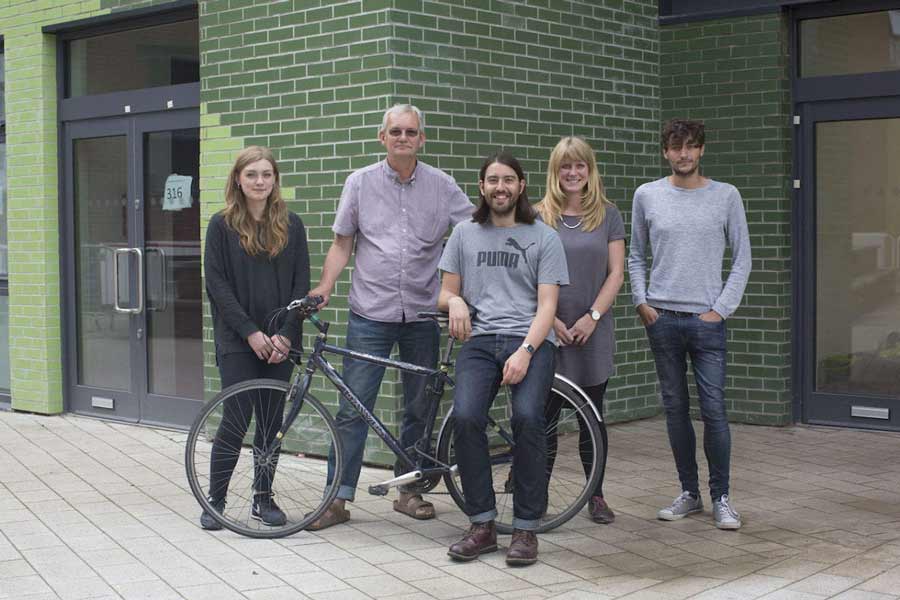
But instead, I’ll tell you about the man I came to know. A man who referred to his passion as an obsession — not with the theatrical flair of someone performing genius, but with the calm inevitability of a person who accepts that true devotion will always trespass into the territory of compulsion. It was the kind of confession only those of us afflicted with the same unruly, lifelong hunger for photography could recognise immediately.
A man who was disarmingly blunt and quick-witted, who laughed with unembarrassed volume, who gave with a generosity that felt effortless, and who fought tirelessly for others to succeed — so long as they were genuinely good, of course. Standards are standards.
We became friends over a few prints in the Foundation archive that same year. One from Ray’s a Laugh by Richard Billingham, another by Paul Trevor. I identified them — correctly, mercifully — and was met with Martin’s characteristically economical verdict: “Good. Shall we have a tea?”
And just like that, I found myself — bewildered, grateful, and slightly unsure how I’d earned it — welcomed into his orbit. From wandering St Paul’s Carnival, making zines and impromptu exhibitions, to watching him champion women and creatives of colour with a conviction that never once asked for applause, to filming the two of us pretending (quite badly) to be on a beach in a studio in Bristol, I realised that friendship with Martin was a collage of the serious, the surreal, and the satirical in equal measure.
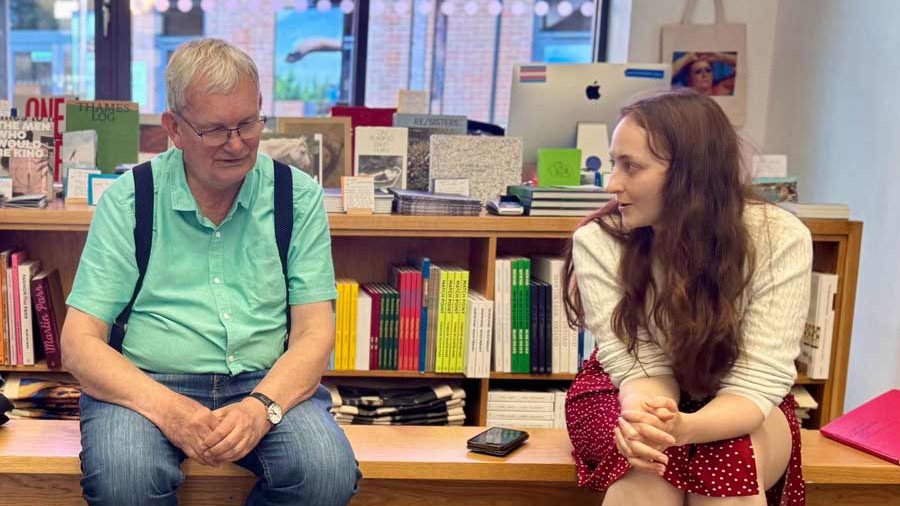
And now, I will always remember Martin exactly as he spent so many hours: sitting quietly in the Foundation, settled into his sofa, tastefully, and somewhat hilariously, adorned with a Gucci pillow bearing his own face. He is leafing through books and prints sent to him by photographers from across the UK. Tea in hand, absorbed, content.
In that silence, I had some of the best conversations of my life. Conversations built not from words, but from shared obsession, from the reverent turning of pages, from the kind of mutual understanding that photography grants to only a few; that photography can communicate what language simply cannot.
From driving around Bristol from exhibition to exhibition in his car, to viewing vintage prints with him, friends Rudi and Tracy in a humble two-up two-down, the extent of Martin’s influence on my career became unmistakably clear. Through him, I met some of the finest people I will ever know and made memories that feel permanently etched into who I am. I can only hope, in whatever small way I can manage, to impact photography — and photographers — the way he so effortlessly did.
If I ever manage to influence photography even a fraction as much as he did, it will be by accident, and with many failures prior.
So, I’ll honour him the only way that feels appropriate: by keeping the obsession alive, drinking far too much tea, and talking about new work. Which, frankly, feels like the most Martin way to do it.
Sign up for our newsletter today!
- Subscribe for exclusive discounts and special offers
- Receive our monthly content roundups
- Get the latest news and know-how from our experts