
As a street photographer, your job is to capture a fleeting moment that tells a story, evokes emotion and feels visually pleasing in a single frame. It’s tempting to think that timing alone is the magic ingredient, but there is something else at play. Caring about the entire frame, everything within it and how it works together can turn a good moment into a spectacular one. When the frame is doing its job, the photograph becomes much more than the moment itself.
To help you begin seeing this way, focus on just three key elements each time you take a photo: light, separation, and the one that you may not have thought of — geometry! Using geometry in your composition has the power to elevate your images far beyond capturing a moment with great light.
Of course, sometimes the moment happens so quickly that there’s no time to consciously think about anything, especially composition. But with practice, training your eye to notice these elements means you’ll pick them up automatically, even when everything is happening at speed.

Everything in your frame should lead the viewer to where you want them to look. If you don’t take control of that, it’s like placing a famous sculpture in a dimly lit corner of a museum and giving the spotlight to a nearby bin. Guiding the viewer’s eye is your responsibility, and by being mindful of light, separation, and geometry, you learn to do that naturally, again and again.
Let’s take a quick look at each element…
1. Light
Without light, there is no photograph. So it’s worth paying close attention to the light’s direction and quality. I’m a sunny-day photographer, so unless I say otherwise, any reference to light refers to the sun.
When the streets are busy, it’s surprisingly easy to forget to check where the light is coming from. I still catch myself needing to do this after more than a decade of shooting. Not paying attention to light direction is one of the most common mistakes I see street photographers make.
You may prefer shooting into the sun for strong silhouettes, and that’s completely fine. I don’t shoot many silhouettes these days, but when I do, I like what I call “front-lit” silhouettes. For these shots, I’m in the shade, the background is lit by the sun, and the person creating the silhouette is also in the shade. It gives a crisp, clear shape.
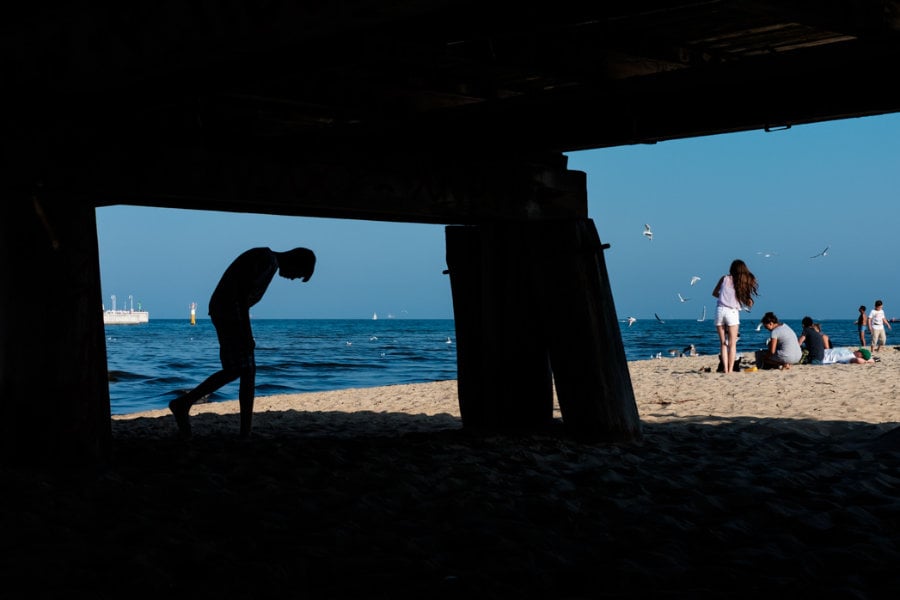
Even on cloudy days, it’s worth checking for light direction. Cloud cover doesn’t always produce evenly diffused light; the sun is still up there somewhere. I check by holding the back of my hand out and slowly turning in a circle to see which side looks brightest. I probably look like I’m practising slow-motion martial arts on the pavement, but it works. The difference might be subtle, but that subtle shift can mean the difference between a dull face and a beautifully lit one.
2. Separation
Your subject needs to stand out for them to be recognised instantly as the subject of your photograph. Everything in the frame should guide the viewer to them, and separation is one of the most effective ways to make that happen.
You might also see separation called “isolation” or “figure-to-ground relationship” (FGR), a term from Gestalt visual perception. I go deeper on that in my book, but you don’t need the theory to begin using it!
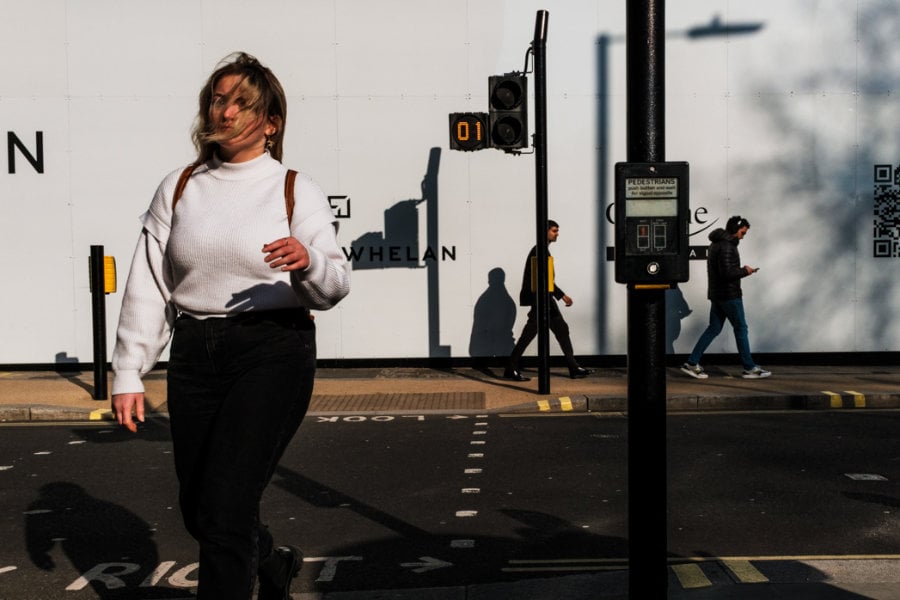
Your job is simply to ensure there’s enough separation between your subject and the background or other people. That doesn’t mean they need empty space all around them. That’s rarely possible in busy streets. But you can still work with what you have:
Contrast
If your subject wears dark colours, position them against something lighter, and vice versa.
Avoid protrusions
Watch for trees, poles or signs sticking out of your subject’s head.
Separate people from people
- Full separation: If the street isn’t too busy, try to separate individuals clearly and use as many evenly spaced figures as you can.
- Face separation: In crowded scenes, faces are what matter most. Bodies can overlap, but your subject’s face needs clarity.
And yes, it even helps to separate objects from objects. Every small improvement adds up.
There’s also “anti-separation”, where you deliberately line someone up with something in the frame for intentional visual trickery. It must look deliberate to work!
3. Geometry
Now for the unexpected one. Geometry.
Most beginners don’t think about geometry at all, yet our brains react to it instantly. You don’t have to work hard to find it. It’s everywhere. Diagonal lines. Repeated shapes. Subframes created by arches, windows, circles, rectangles. Typography on street signs and storefronts.
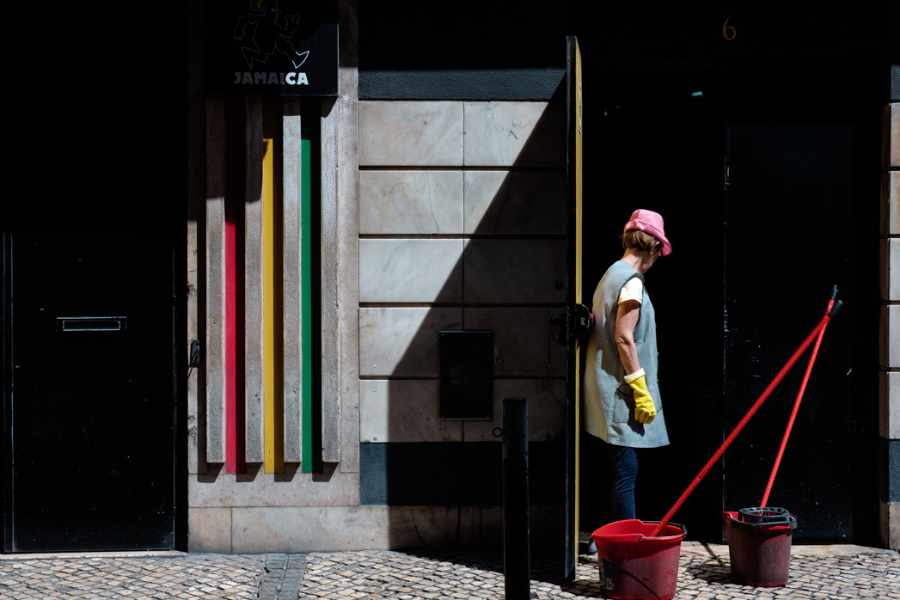
All of this is geometry.
These elements don’t just look pleasing, they guide the viewer inside the image and create structure.
And this is only the beginning.... There are visual cheat codes that can take your compositions to a completely different level. Those are waiting for you inside my book: Stop Looking, Start Seeing.
About the Author
Polly Rusyn is an author, street photographer and owner of dostreetphotography.com. If you want to go deeper into what makes a street photograph work, how the brain reads images, and how to compose with real intention, you can explore all of it inside her book: Stop Looking, Start Seeing.
The Wex Blog



Sign up for our newsletter today!
- Subscribe for exclusive discounts and special offers
- Receive our monthly content roundups
- Get the latest news and know-how from our experts