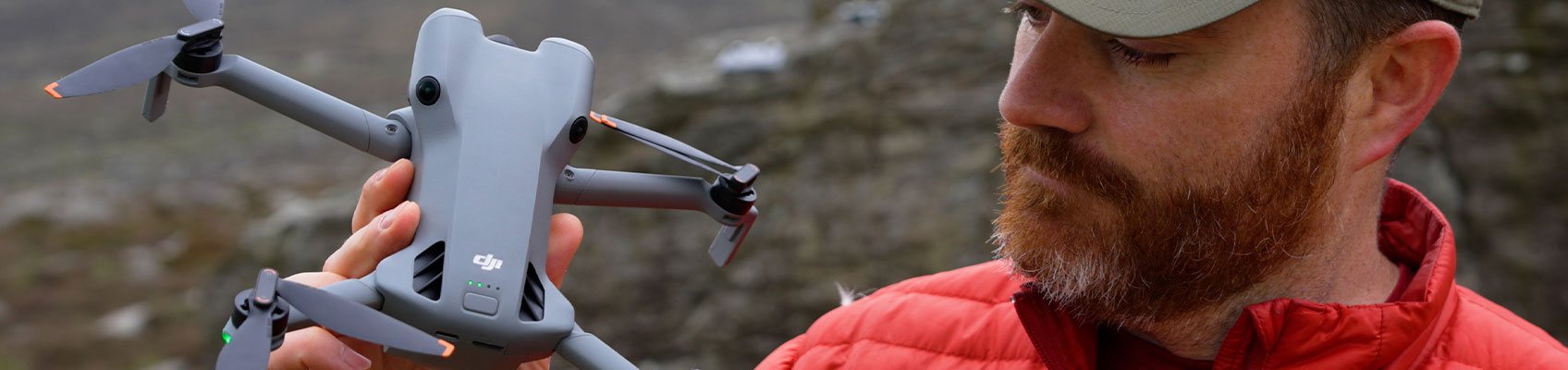
Stephen J Reid knows his drones. An outdoor filmmaking expert with more than 186,000 subscribers on YouTube, he spends a huge amount of time assessing the pros and cons of all the major consumer drones for filmmaking. As such, when we were putting together a guide to top drones for filmmaking and content creation, he was our first choice of go-to expert.
Stephen has compiled for us a rundown of the best drones, in categories that content creators are actually going to use. That means that he hasn’t included the ultra-heavy and specialist drones designed for Hollywood film production. This is a list of drones that the average user can reasonably afford, transport, and learn to use.
The drones on this list are split into three key categories: pocket, mini and medium. Stephen has explained the pros and cons of each category, and provided specific drone suggestions for each one – so, let’s get into it!
Pocket drones
As you might expect, this is the smallest type of drone we’ll be considering – capable of literally fitting into a pocket when folded (well, a fairly large pocket, but still). These are drones that don’t even require a controller – they can fly autonomously, following selectable pre-set patterns such as follow or selfie. Some also offer gesture control, meaning you can instruct them to move in various directions via arm gestures.
As Stephen says, this is the drone that you can get out of your pocket and fly the fastest. While they fly autonomously, pocket drones do also offer manual flight control, with controllers often available as optional extras, or app-based control available via a smartphone Wi-Fi connection. Though, as Stephen points out, Wi-Fi is quite limited in range, so you’ll have to keep the drone close!
A key downside to pocket drones is inherent to their size – the small, lightweight frame means they are very susceptible to windy conditions. As Stephen says, you probably wouldn’t want to be using one of these on top of a mountain! But they are the most affordable and easiest-to-use types of drone on the market, and they can still capture great footage.

|
Pros:
Cons:
|
Key specs: Sensor: 12MP 1/2-inch CMOS Weight: 151g Max video resolution: 4K Flight time: 19 minutes |
This is Stephen Reid’s top pocket drone pick. The DJI Neo 2 isn’t just one of the best pocket drones – it’s also one of the most affordable, boasting excellent all-around performance. It can intelligently follow you, offering a number of pre-set flight modes, and also allowing for manual control via the DJI RC-N3 controller. And unlike some rival pocket drones, it also boasts omnidirectional Obstacle Sensing thanks to LiDAR and infrared protection.
With a 12MP 1/2-inch CMOS sensor, the DJI Neo 2 produces good-looking, vibrant 4K footage and stills from the air. As we’ll see, there are plenty of larger drones that offer greater quality and more sophisticated video options, but as Stephen puts it, this is the best drone option for casual users who want the easiest possible drone to fly. If you’re a runner, cyclist or skier, for example, who wants to capture dynamic footage of your activities, this drone will give you creative freedom and flexibility, in a very small package, on a tight budget.
Mini drones
Mini drones are the next step up from pocket drones. This is quite a broad category, running from very affordable options to drones that produce professional-level video quality – and for Stephen, it’s the most interesting category. The majority of outdoor drone footage that Stephen produces for his professional work is captured using mini drones.
Mini drones weigh less than 250g, meaning that they are not subject to the more extensive licensing/flight restrictions in the drone code. Offering tracking capability and full manual control via a dedicated controller, mini drones will generally also offer fantastic photo and video quality, with raw and Log shooting options for a professional workflow.
Offering longer flight times and more sophisticated obstacle avoidance than pocket drones, mini drones provide what Stephen calls the best balance of price and performance.
Here are his two top picks.
Best mini drone:

|
Pros:
Cons:
|
Key specs: Sensor: 50MP 1-inch CMOS Weight: 249g Max video resolution: 4K HDR Flight time: 36 minutes |
A powerful mini drone in all senses, the DJI Mini 5 Pro is Stephen’s overall top pick in the mini drone category. It packs in a 1-inch sensor with 50MP of resolution. The larger physical size of the sensor delivers much greater dynamic range compared to the 1/2-inch CMOS of the DJI Neo 2, while that generous 50MP of resolution allows for a lossless digital zoom, meaning you can effectively simulate a telephoto perspective.
With powerful motors, it’s capable of achieving impressive flight speeds with strong wind resistance – though with the sub-250g weight of the drone, there is a limit to the level of wind-speed it can handle! Its obstacle avoidance is also highly sophisticated, and works at night-time.
Best affordable mini drone:

|
Pros:
Cons:
|
Key specs: Sensor: 48MP 1/1.3-inch CMOS Weight: 249g Max video resolution: 4K Flight time: 52 minutes |
This is Stephen’s pick for anyone whose budget can’t quite get to the DJI Mini 5 Pro. While its sensor is a smaller 1/1.3-inch type, it can still capture crisp and detailed 4K footage in a range of conditions. Its smaller motors mean that it isn’t quite as capable in high wind situations – Stephen explains that it’ll manage a wind-resistance of up to 10 m/s, compared to 12 m/s on the DJI Mini 5 Pro.
However, the DJI Lito X1 is more affordable, and it also has one other key advantage over the Mini 5 Pro – significantly longer flight times of up to 52 minutes. As Stephen explains, he spends a lot of his time with his drone hovering in the air, waiting for something to happen or for the light to change. So, longer flight times can be a significant advantage.
Medium drones
This is the final category of drone that Stephen recommends most content creators consider. With increased weight and size, medium drones offer greater flight power, more sophisticated features like obstacle avoidance, and superior image quality with a suite of video options.
The downside is the increased weight and size. The fact that medium drones weigh more than 250g means that you will be subject to legal requirements when flying them in populated areas, and may have to obtain additional certification to do so. The rules will vary depending on where you are based – make sure to keep up with the Drone Code for your local area.

|
Pros:
Cons
|
Key specs: Sensor: 50MP 1-inch CMOS Weight: 724g Max video resolution: 4K Flight time: 45 minutes |
Everything that the DJI Mini Pro 5 does, the DJI Air 3S pushes a step further. It boasts longer flight times, more motor power for better wind resistance, and forward-facing LiDAR. And, what’s more, it uses multiple lenses, meaning its zooming capability is optical rather than digital. This massively improves its filmmaking versatility, allowing the creation of many different types of shot from a single platform.
Even though it weighs significantly more than a mini drone, the Air still folds down relatively small – Stephen points out that when folded it’s not much bigger than a water bottle, meaning you can easily fit it in a small backpack. But of course, the larger weight category will mean that you may need to acquire additional licensing to fly it safely in populated areas.
Why no FPV drones?
Those of you who know your drones may have been surprised that Stephen hasn’t picked any FPV (First Person View drones) for his list. As the name implies, these are drones that allow you to fly from a first-person perspective, wearing goggles that literally show you what the drone’s cameras are seeing.
It’s an incredibly acrobatic and immersive experience, one that any drone enthusiast should definitely try out if the opportunity comes up. However, for Stephen, there are four key downsides to FPV drones that mean they’re probably not the best choice for content creators.
- They’re complicated. The experience of FPV flying has an unavoidably steeper learning curve than other types of flying, even if you use a smart controller rather than going fully manual.
- Short battery life. FPV flying is power-intensive, and the flight times tend to be on the short side. This makes them less useful for content creators trying to bag a list of shots.
- Very wide-angle lens. The ultra-wide angle perspective of FPV drones is great for piloting, giving you an immersive view of your surroundings, but is less useful for capturing exciting imagery. It can make everything look a bit flat.
- More anti-social. FPV drones are extremely loud, their motors producing a distinctive high-pitched whine. While you’ll obviously be fine in an isolated area, if you’re flying near neighbours, it could be an issue.
Watch the full video here:
About the Author
Jon Stapley is a London-based freelance writer and journalist who covers photography, art and technology. When not writing about cameras, Jon is a keen photographer who captures the world using his Olympus XA2. His creativity extends to works of fiction and other creative writing, all of which can be found on his website www.jonstapley.com
How do we decide?
Our in-house photography specialists, store staff, and industry partners work together to review our buying guides and advice articles. We also monitor emerging trends and listen closely to customer feedback, ensuring our recommendations stay current and relevant to what photographers and filmmakers are actually looking for.
By carefully curating the products we recommend, our guides are designed to offer clear, trustworthy advice that helps customers choose the right kit with confidence.
If you would like further advice, our contact centre team are here to help. You can also reach us via email or social media. And remember, if you purchase based on our recommendations, your order is covered by our full returns policy.
Explore our range of photo and video equipment

Trending Buying Guides
Sign up for our newsletter today!
- Subscribe for exclusive discounts and special offers
- Receive our monthly content roundups
- Get the latest news and know-how from our experts