If you’re into landscapes, the right lens makes all the difference. Think big skies, mountain peaks, rolling hills and quiet forests. Capturing scenes like these isn’t just about pointing your camera and pressing the shutter. The best lens for landscapes helps you bring all that drama, depth and beauty into your shots.
Most people reach for a wide-angle lens, and for good reason. It lets you fit more of the scene in and makes those foreground details pop. But don’t forget longer lenses can work wonders too - sometimes zooming in to pick out layers of hills or a single tree on the horizon creates just as much impact.
That’s why we’ve pulled together this list of the best landscape lenses across all the major camera systems. These are the lenses that’ll consistently give you a crazy level of detail and stunning natural colours.
Right. Grab your boots (and maybe a flask of tea), and let’s take a look at the best lenses for landscapes.

Pros:
- Exceptionally sharp, even at the edges
- Built-in 5-stop image stabilisation
- Weather-sealed L-series build
Cons:
- Expensive compared to alternatives
- Still fairly large for an ultra-wide
Canon’s EF 16-35mm lenses were long-standing favourites for landscape photographers, providing versatility and reliability in an ultra-wide format. It was inevitable, then, that Canon would create a premium RF-mount equivalent, and the Canon RF 15-35mm f2.8L IS USM more than delivers on that promise.
Offering a slightly wider 15mm focal length, this lens provides dramatic breadth for expansive scenes while maintaining superb sharpness from corner to corner. The addition of 5-axis image stabilisation is a real boon, making handheld shooting far more practical when a tripod isn’t available. Build quality is what you’d expect from a pro-grade L-series lens - weather-sealed, solid, and ready to withstand the elements.
Of course, it comes at a cost though - both in terms of price and size. This isn’t a small lens to sling in a hiking bag without thought. But for those who want the very best Canon RF ultra-wide for landscapes, this is the one to beat. For a lighter, more affordable alternative, the Canon RF 14-35mm f4L IS USM is well worth considering.
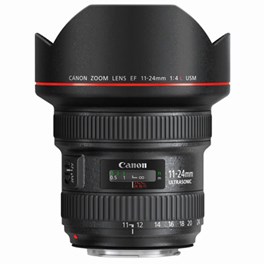
Pros:
- Incredibly wide angle of view
- Constant f4 aperture
- Rectilinear design
Cons:
- Very heavy for a wide-angle
- Cannot take filters
The Canon EF 11-24mm f4L USM Lens is a legend. It’s the widest zoom lens with a rectilinear design – as opposed to a fisheye/curvilinear design – meaning that it captures an incredible angle of view without causing straight lines to be significantly curved. As sheer feats of engineering go, it’s quite an achievement, and the end result is an astounding lens that produces striking landscape images, and does so with a constant aperture of f4.
This lens fits Canon’s full-frame EF-mount DSLRs. Bear in mind that it doesn’t support a filter thread due to its bulbous front element, so you may want to consider getting an adapter like the Lee SW150 Mark II, which is designed especially for this lens.
If the 11-24mm is out of your budget or you’re using a smaller system, consider the Canon EF-S 10-18mm f4.5-5.6 IS STM lens, which fits Canon’s APS-C DSLRs like the EOS 250D.
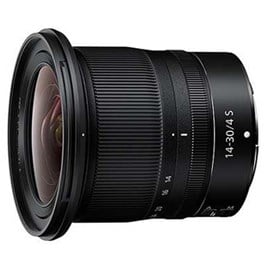
Pros:
- Superb, high-quality optics
- Can directly attach filters
- Customisable control ring
Cons:
- Some may prefer an f2.8
- No Vibration Reduction
This was a relatively early lens in the Nikon Z-mount range, and it showed right away Nikon’s ambitious approach to pushing this system forwards. It’s a spectacularly sharp full-frame wide-angle lens, with exceptional optics that make for flat-out stunning colour rendition and contrast. Distortion and colour fringing are basically non-existent, and the sharpness extends all the way into the corners of images. Incredibly impressive stuff all-around.
One thing that’s particularly notable about this wide-angle lens is that it can accept screw-on filters with an 82mm thread size – which is unusual for lenses that extend all the way to a 14mm wide-angle perspective. This means you can make liberal use of NDs, grad NDs and polarisers, all of which are hugely useful for landscape shooting, allowing you to take control of the light. The Z 14-30mm lens is very portable too, and has been weather-sealed for outdoor use.
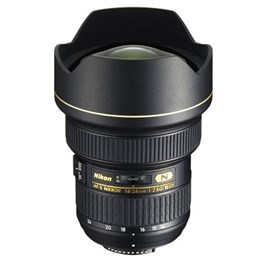
Pros:
- Top-notch sharpness and colour reproduction
- Weather-sealed
- Wide, rectilinear design
Cons:
- Can’t take filters
- More than 1kg weight
Similar to Canon’s 11-24mm featured above, this is Nikon’s flagship ultra-wide rectilinear zoom lens. While the Nikon 14-24mm f2.8 G AF-S ED doesn’t reach such a dizzyingly wide angle of view, it’s still immensely useful for landscape photographers, and delivers optical quality in spades. Thanks to the large-diameter Precision Glass Molding (PGM) element, coma aberration is virtually eliminated, and the lens also benefits from Nano Crystal lens coatings that ensure colour reproduction is top-notch.
The bulbous front element of this lens prevents filters from being screwed on (as does the permanently screwed-on hood that controls for flare), so you’ll need to bear that in mind when planning your shoots. Also, weighing in at more than 1kg, this lens and an FX-format Nikon DSLR are going to make for a hefty pair, so a good camera support is going to be a must.
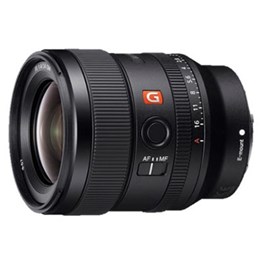
Pros:
- Class-leading optical quality
- Not ridiculously heavy
- Comprehensive weather-sealing
Cons:
- Prime lens may not be for everyone
While we’ve mainly focused on zoom lenses in this guide, many landscape photographers appreciate a prime for its top-tier optical quality and larger maximum aperture. The Sony FE 24mm f1.4 G Master is one of the best prime lenses around right now, and its 24mm focal length makes it pitch-perfect for landscape photography. Designed to meet the needs of high-resolution cameras like the Sony A7R V, it uses a construction of 13 optical elements to deliver images of unparalleled sharpness right to the edges of the frame.
One thing we really appreciate about this lens is that it isn’t too heavy. While not every photographer minds a heavy lens, it can be restrictive for some, and it’s great to see that Sony didn’t get carried away and turn its 24mm G Master into a lumbering dreadnought. Weighing just 445g, with a filter thread diameter of 67mm, it balances beautifully with Sony’s full-frame E-mount cameras.
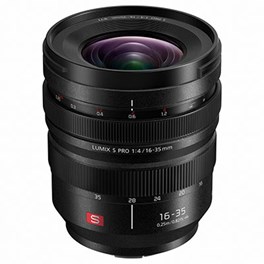
Pros:
- Excellent sharpness even at f4
- Well-engineered handling
- Leica-certified optics
Cons:
- Not as wide as other premium landscape lenses
In the full-frame corner, we have a beautifully engineered, Panasonic-made lens for the Lumix S system, the Panasonic LUMIX S Pro 16-35mm f4. While it may not go quite such a wide angle of view as the premium landscape lenses we’ve seen from the likes of Canon and Nikon, the LUMIX S Pro 16-35mm is built to Leica-approved standards of optical excellence, meaning it is very, very sharp indeed. Handling on the lens is wonderful, with a useful focus clutch mechanism that makes it easy to switch between auto and manual focus should you wish to fine-tune.
This is a lens with an f4 maximum aperture, and it’s sharp enough that the f4 setting is credibly in play for landscape photographers, who often need to stop down to get the lens into its sharpness sweet spot. Another thing that aperture helps with is the overall weight of the lens – not having f2.8, which most landscape shooters probably won’t use anyway, means it can stay at a svelte 500g.
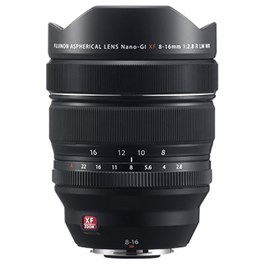
Pros:
- Constant f2.8 aperture
- Complete weather sealing
- Magnificent technical quality
Cons:
- Quite front-heavy on Fujifilm bodies
- Corner softness at the widest setting
A seriously capable wide-angle landscape lens for the Fujifilm X series, the Fujifilm XF 8-16mm f2.8 R LM WR is an outstanding optic that deserves to be paired with the very best Fujifilm cameras like the X-T5. The detail delivered by this lens really is razor sharp across the frame, aided by a field curvature correction mechanism. This results in pretty much flawless performance throughout the zoom and aperture ranges (there’s just a tiny bit of corner softness at 8mm, but not enough to seriously worry about).
The lens is weather-sealed, with a magnesium-alloy body, and has a constant aperture of f2.8 that expands its utility in low light. One thing to bear in mind is that while it’s not a heavy lens, it does make for quite a front-heavy setup when mounted to many X-mount cameras. Something to be aware of when you’re positioning your tripod.
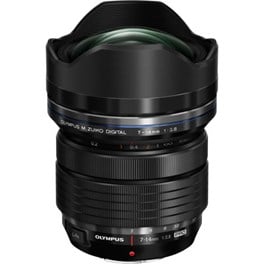
Pros:
- Super-wide rectilinear design
- Pro-grade handling
- Weather-sealed metal build
Cons:
- No filter attachment
PRO by name, pro by nature – the Olympus M.Zuiko Digital ED 7-14mm f2.8 PRO lens is a serious beast for landscape photography, and any Micro Four Thirds user with the budget for it should be seriously considering it. We love the way this solid lens is constructed all from metal, it really helps give it that premium feel, and the weather-sealed build will pair well with both Olympus and later OM SYSTEM cameras.
Of course, all this wouldn’t mean much if the image quality wasn’t there, but the ultra-wide rectilinear design of the M.Zuiko Digital ED 7-14mm (which delivers an equivalent range of 14-28mm) is up there with the best. Even when used at that wide f2.8 aperture, it still delivers the goods in terms of sharpness and contrast – though f5.6 is probably your best bet for optimum results.
How to choose
You may be wondering what are the main criteria we’re looking at for landscape lenses? So, before we start the list, let’s quickly run through the key points you’re looking for in a good landscape lens. Remember, you can always consult our photography jargon-buster if you’re unfamiliar with any technical terms. And, it's also a good idea to consider the best camera for landscape photography.
Wide-angle focal length - This isn’t necessarily a requirement – plenty of great landscapes have been shot on standard and even telephoto lenses. However, it’s undeniable that wide-angles are heavily favoured by landscape photographers as they are perfect for fitting huge, sweeping vistas into an image. Many landscape shooters favour a short zoom for more flexibility, though primes can also have their place. We’ve focused mostly on wide-angles for this guide, though have included some great standard lenses where we feel they merit inclusion. We have also included both zooms and primes.
Edge-to-edge optical quality - Obviously photographers in all disciplines want their images to be sharp. However, in landscape photography it is particularly important that we don’t see too much fall-off in the corners as we’re generally not just documenting a single central subject, but a whole expansive scene.
Weather-sealing - Landscape photography is by its nature an outdoor pursuit, so you ideally want a lens that can handle a bit of rainfall without needing to be rushed back into the bag. Good weather sealing also means that you can venture into snowy conditions to capture dramatic, wintry images – just make sure to wrap up warm.
While this may sound like it’s going to add up to an expensive lens, there are a lot of features that landscape photographers can afford to compromise on. For instance, you don’t need to worry about fast autofocus – the landscape isn’t going anywhere. Built-in stabilisation can be nice to have in landscapes, but it isn’t essential, as you’ll almost certainly be using a tripod.
Having an ultra-wide aperture isn’t especially vital in landscape, as you’ll likely be stopping down to increase your depth of field. Portrait and street shooters would likely turn their noses up at an f4 lens, but for landscapes, it’ll serve perfectly well.
FAQs
What focal length is best for landscape photography?
A focal length between 14mm and 35mm is generally considered best for landscape photography. However, the exact focal length depends on personal preference and the specific composition you want to capture.
What is the difference between a wide-angle and a standard lens?
A wide-angle lens has a shorter focal length than a standard lens, allowing it to capture more of the scene in a single frame. This makes it a popular choice for landscape photography, as it can capture the full scope of a vast landscape.
Can I use a zoom lens for landscape photography?
Yes, a zoom lens can be used for landscape photography. However, prime lenses are generally preferred for their higher image quality and wider aperture, which can help capture more light in low-light conditions.
What is the best aperture for landscape photography?
The best aperture for landscape photography is typically between f8 and f16. This aperture range offers a wide depth of field, allowing the entire scene to be in focus.
Should I use a tripod for landscape photography?
Using a tripod for landscape photography is highly recommended, as it helps stabilise the camera and reduce camera shake. This is especially important when using longer shutter speeds or when shooting in low-light conditions.
How do we decide?
Our in-house photography specialists, store staff, and industry partners work together to review our buying guides and advice articles. We also monitor emerging trends and listen closely to customer feedback, ensuring our recommendations stay current and relevant to what photographers and filmmakers are actually looking for.
By carefully curating the products we recommend, our guides are designed to offer clear, trustworthy advice that helps customers choose the right kit with confidence.
If you would like further advice, our contact centre team are here to help. You can also reach us via email or social media. And remember, if you purchase based on our recommendations, your order is covered by our full returns policy.
Sign up for our newsletter today!
- Subscribe for exclusive discounts and special offers
- Receive our monthly content roundups
- Get the latest news and know-how from our experts