
If you’re looking for the best binoculars, we’ve got you covered. In this guide we’ve assembled our team’s top picks of binoculars for birdwatching, sports, safari, stargazing and more, with flexible options for a range of budgets. In short, if you need a good pair of binos, you’ll find them here.
Binocular designs vary quite a bit, and individual sets are generally designed for a specific purpose, so it pays to get the right binoculars for your particular use case. Some may prioritise distance, with a powerful zoom, while others may field a larger objective lens to improve light transmission and allow you to view in dimmer conditions.
If you’re new to binoculars and aren’t sure how they work, you’re in luck. We’ve also put together a detailed piece on how binoculars work to explain all the technical terminology, including the numbers and the technical jargon, so you can head there for a primer. You can also use the section buttons above to navigate to a specific type of binoculars if you know what you’re going to be using them for.
In this guide, we'll cover the...
Best binoculars for bird watching
Best binoculars for astronomy
Best marine binoculars
Best safari binoculars
Best night vision binoculars
Best sports binoculars
Best Bird Watching Binoculars
There are many, many, many different types of binoculars but first things first - you have to decide what you’re using them for. For birdwatching, you need to decide whether you need reach or the ability to scan and pan along the skies. Fortunately, we offer both options. The higher magnification binos allow you to pick out the fine details of your subjects. The lower magnification, lighter etc. binoculars allow you to acquire your subject and track them through the sky.
Pros:
- Offers an exceptionally wide field of view
- Premium optics and craftsmanship provide unparalleled quality
Cons:
- A very expensive pair of binoculars (but worth every penny)
- Great for scanning large areas but not built for observing fine details
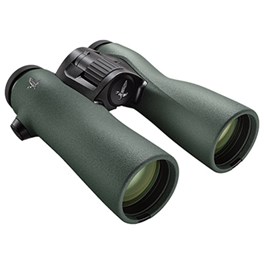
This is an exceptional pair of binoculars. Swarovski is a name synonymous with optical excellence, and the NL Pure 8x42 Binoculars live up to that rep. Offering an extremely impressive 69-degree field of view, the NL Pure Binoculars use pin-sharp lenses that have been treated with specialised coatings. The result is superior light transmission and top-notch subject definition.
The binoculars are fog-proof, with 18mm eye relief for comfortable prolonged use. A new focusing mechanism makes the focusing action smooth and intuitive. It’s light but not too light – perfectly judged for use in the field. For spotting birds, these are some of the best binoculars you can buy, the wide field of view and fast focusing giving you exceptional flexibility. The build quality feels as premium as you’d expect, and the binoculars come with a clutch of useful accessories, including a comfort strap, a carry bag and a kit for cleaning.
Pros:
- Nitrogen Purged meaning they’re waterproof and fog-proof
- Affordable and comes with Hawke’s lifetime warranty!
Cons:
- Not as ergonomic and tactile as other pairs
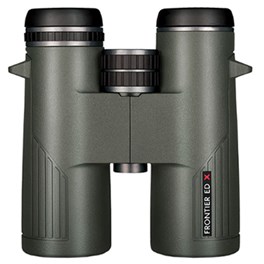
For a much more affordable birding option, we’d recommend this pair of capable binoculars from Hawke. Delivering high-quality viewing thanks to a set of precision optics, the Hawke Frontier ED X 10x42 binoculars use extra-low dispersion optics to minimise chromatic aberration. The lenses have also been treated with water-repellent coatings, protecting them from rainfall, and inside the binoculars have been nitrogen-purged as an anti-fogging measure.
With a 42mm objective lens, the Hawke Frontiers offer very good light transmission, and produce a sparklingly clear image. The chassis of the binoculars is constructed from magnesium alloy – it may not quite have the premium feel of a pair like the Svarovskis, but well, that’s why you’re paying a fifth of the price. Something we also especially like about these binoculars is the lifetime warranty Hawke offers. In the event of any damage or defect to the product, you’re covered, and set up for a lifetime’s happy birdwatching.
Best Astronomy Binoculars
It’s dark at night and because of that, when looking for suitable astronomy binoculars, you should look for a pair with large objective lenses. This will let the most amount of light in to help you view the stars! A larger objective lens will make the overall size and weight larger but for this, you can get accessories to mount them to a tripod for a steady, shake-free shot.
Pros:
- Very affordable and ideal for those starting out with star gazing
- 80mm objective lens offers maximum image brightness in low-light
Cons:
- While perfect for beginners, its image quality may not be suitable for more seasoned users
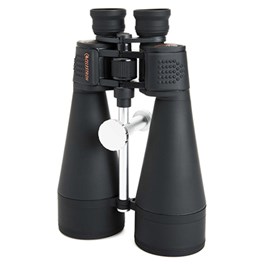
With 20x magnification and a big 80mm objective lens, these are serious binoculars for seeing the stars – and even better, they’re much more affordable than you might expect. Celestron is probably best known for its stargazing telescopes, so the makers of this pair of binoculars know what they’re about when it comes to stargazing.
The view is pleasingly sharp from edge to edge, with multi-coated optics to ensure optimal clarity. Once again, the outer covering is rubber, making it both extra-grippy and able to take a bit of a knock. The focusing action is reasonably smooth, controlled by a large central knob, and once again there’s a lifetime limited warranty for a bit of extra peace of mind.
We also like the long eye relief of the Celestron SkyMaster 20x80 Binoculars, which makes them suitable for use while wearing glasses. There’s a tripod adapter too, which can be handy for prolonged viewing.
Pros:
- Affordable and versatile - along with astronomy, they’re ideal for safaris, hiking, trips and more
- Surprisingly lightweight meaning you can hold the binos for longer without fatigue
Cons:
- This pair offers an impressively far optical range, but as a result, the image quality can suffer in certain lighting situations
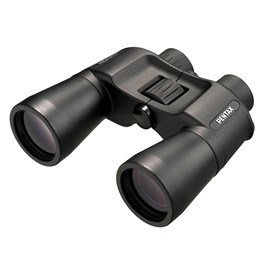
Even cheaper than the Celestron pair, the Pentax Jupiter 16x50 Binoculars are the perfect starter pair for the amateur stargazer. They deliver 16x magnification and sport a 50mm objective lens, which is smaller than the 80mm on the Celestron, but still still pretty good when it comes to light gathering.
The optical design uses a porro prism element, which works differently to a roof prism, using pairs of right-angled triangle prism that reflect light at 90° in order to suppress dispersion. You can spot porro prism binoculars by the way the eyepiece doesn’t line up with the objective lenses at the front.
Once again, the Pentax binoculars have a level of rubber armour to protect against bumps and knocks. The chassis is made from plastic, and certainly doesn't feel as premium as more expensive binos. However, they still offer tremendous value for money for any amateur stargazer.
Best Marine Binoculars
If you’re looking for binoculars for marine observation, there are several factors to be considered. An absolute must is a pair that have gas-filled tubes - this will ensure that the lenses do not fog up and will be waterproof! You should also be on the lookout for corrosion/temperature resistant polycarbonate - it’s lightweight, durable, and will withstand saltwater environments.
Pros:
- Water and fog-proof built, and its 7x mag. is ideal for marine observation
- Tethered objective lens caps keep the lenses protected from dust, dirt, scratches, and breaks
Cons:
- They will float on water if the neckstrap is attached properly - but without the strap, they’ll sink!
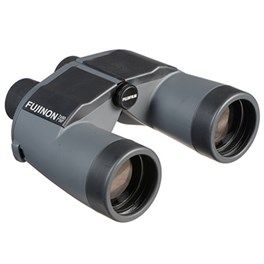
These hardy waterproof binoculars are tailor-made for marine viewing, and offer a number of clever features that make them excellent value for money. For one, they not only provide excellent clarity of image thanks to multi-coated optics, but also have individual focus mechanisms for each lens, which can be useful for those who have pronounced differences between their eyes. This is accomplished via the dioptre ring.
With eye relief of 18mm, these binos are well suited to anyone who wears glasses. They also come with a number of useful accessories, including a strap that also acts as a flotation device, a light polycarbonate case for safe transportation, and a cleaning cloth to keep the lenses free from dust and dirt. Thanks to their wide angle of view and excellent light transmission, the Fujinon 7x50 WP-XL Mariner Binoculars make for splendid underwater viewing.
Pros:
- Its Porro prism design is built with premium optics and provides accurate depth perception - ideal for marine use
- Nitrogen-filled tubes prevent fog or moisture formation on the lenses that would damage the optics
Cons:
- The batteries installation can be tricky (but it’ll be worth it)
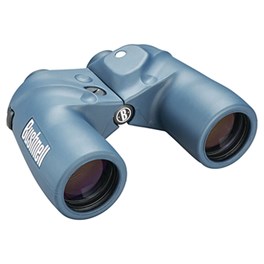
Batteries on a pair of binoculars? It might seem odd, but it’s because the Bushnell Marine 7x50 Bearing & Ranging Binoculars have a built-in illuminated compass, which can be a godsend for navigation in the dark, particularly if you plan to take them out sailing. Also incorporated is a rangefinder that’s intended for measuring the distance and size of objects. All this is wrapped in a hardy rubberised shell that can take a knock or two, with an anti-slip design that reduces the risk of droppage.
This is another porro prism design (the non-aligned eyepieces and lenses are the giveaway), and it reliably produces a bright and clear image. The binoculars include nitrogen-filled tubes that are an effective anti-fogging mechanism, and the waterproofing is assured thanks to the O-ring sealed design. These are popular binoculars in the marine and sailing community, and it’s easy to see why.
Pros:
- This pair will excel for marine use but can easily be used for most purposes
- An ergonomic design that’s also waterproof, fog proof and shockproof
Cons:
- Do not perform as well in low light as other binoculars, but it’s a small trade-off considering the price and overall performance
Anyone who’s regularly spending time on the Wex site is probably already aware of Nikon’s reputation for optical excellence, and these action binoculars do not disappoint. The Nikon Action EX 7x50 Binoculars aren’t just marine binoculars – they’re basically everything-binoculars. So, not only do you get waterproofing, but also a shockproof body, an all-metal chassis, a polycarbonate shell and a rubberised non-slip grip.
Image-wise, the binoculars excel. With high-resolution lenses that are made using Nikon’s proprietary Eco Glass, they incorporate anti-reflective coatings for optimal light transmission. There’s also a unique click-stop eyecup design that allows the user to adjust the eye relief according to their specific comfort level. It’s clever touches like these that make Nikon’s binoculars special, and the Nikon Action EX 7x50 Binoculars are just that. Suitable for all conditions and all terrains, these are binoculars to take everywhere with you.
Best Safari Binoculars
More often than not, if you’re on a safari, you’ll be far away from your subjects (elephants, zebra, and more scarily - lions). Because of this, you’ll need a high magnification with a large objective lens to bring those subjects closer to you but also to produce a bright and highly detailed image. But if there’s not enough space in your bag, a compact pair of roof prism binos could be useful to help you scan the skies or identify landmarks.

Pros:
- Stunningly clear Zeiss-made optics
- LоtuТес lеnѕ соаtіng repels water
- Fast, precise focusing mechanism
Cons:
- Premium price
For viewing on safari, you want the sharpest and clearest binoculars possible, and you can hardly go wrong by going to one of the best optics-makers in the business. Zeiss’s Conquest HDX 10x42 binoculars deliver a superior image of dazzling clarity at distance. This is in part thanks to Zeiss’s famous T* coating, which delivers up to 90% light transmission, and also means you can keep on viewing for longer when the light gets low.
The Conquest HDX binoculars offer superb ergonomics, with a smooth focusing action that works even when the user is wearing gloves. Their outer elements have been treated with LоtuТес lеnѕ соаtіng, which ensures that water rolls straight off and also makes it easy to clean off dust and dirt. There’s a tripod mount, should you want to secure the binoculars for day-long observation, and the body itself is constructed from a lightweight but durable magnesium alloy.
Pros:
- Exceptional image quality and overall performance
- This pair has an extended field of view that makes a substantial difference when viewing from a distance
Cons:
- Expensive compared to similarly ranged binoculars, but when on a safari, this pair will offer the best optical clarity
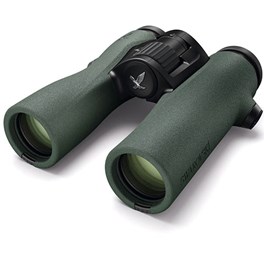
Another premium pair of exceptional optics from Swarovski, the NL Pure 8x32 Binoculars will naturally not be for everyone. However, those willing to take the plunge will be rewarded with some of the best long-distance viewing on the market, with simply superb quality. Ideal for safari, these binoculars use field flattener lenses to deliver an ultra-sharp image from edge to edge, even with an exceptionally wide field of view. In terms of sheer optical sharpness, these binos can’t be beat.
Balancing beautifully in the hand, the Swarovski NL Pure 8x32 Binoculars are comfortable to use for long periods. Focusing is smooth and natural-feeling, with a tactile focus ring that’s also suitable for use while wearing gloves (safaris aren’t always done in hot weather!). For cleaning, the binoculars come with a soap and brush kit, and there’s a useful side-bag for easy transportation.
Pros:
- Exceptional Leica-standard image quality, colour accuracy and high-contrast clarity
- Nitrogen-filled and O-ring sealed; withstanding submersion in up to 4m of water and resistant to internal fogging
Cons:
- Another expensive pair but a worthy and reliable investment that will never fail
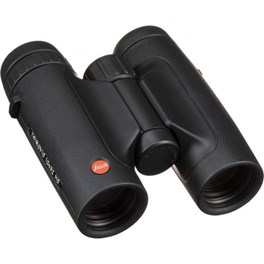
Here’s another name that any photographer worth their salt will know means exceptional optical quality – Leica. Don’t worry though; these optics won’t set you back as much money as a Leica M11. The Leica Trinovid 10x32 HD Binoculars are ideal for safari use, balancing portability, optical quality and hard-wearing design. The internal optics are phase-corrected and multi-coated, with anti-reflective and anti-abrasive treatments – the end result is outstanding light transmission and sharpness. Interestingly, the close focusing distance is an unusually short 1m, which is great if you want to get a close-up view of something that has landed close, like a bird or an insect. For far-off viewing, meanwhile, the binoculars deliver a 104m field of view at distances of 914.4m.
The eyecups are click-stop adjustable, which is great for glasses wearers, and the focusing action is tactile and smooth. Internal nitrogen also prevents fogging. The Leica Trinovid 10x32 HD Binoculars weigh just 640g and come with a useful protective nylon case for transportation.
Best Night Vision Binoculars
The days of night vision binoculars being exclusively a spy’s tool are gone. Nowadays we have various options available to us that allow us to make nighttime observations. We can enjoy watching wildlife at night - seeing what they get up when the sun goes down and light from our lamps go out. Not only this, the once costly and bulky night vision binoculars of the past are now, compact, lightweight and offer a much higher quality image.
Pros:
- It can capture high-quality 1080p video during both day and night
- Its built-in IR illuminator allows for viewing long-range targets day or night
Cons:
- The illuminator has only two brightness levels and the battery life isn’t as good as some other models
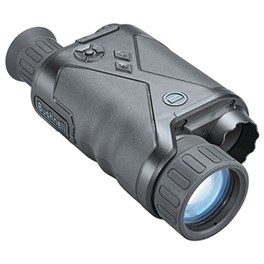
First things first – yes, this is not technically a pair of binoculars, it’s a monocular. However, the Bushnell Equinox Z2 4.5x40 Night Vision Monocular is a highly capable device for seeing in the dark, and is well worth considering, especially if you want something lightweight and portable. The powerful built-in IR illuminator works at ranges of up to 750ft (about 229m), giving you a good deal of range, and the body is well-built with a useful grip.
The Bushnell Equinox Z2 4.5x40 Night Vision Monocular records video in 1080p, and is capable of streaming it directly to a mobile device. This makes it easy to share your night-time discoveries, which you can also record as still images if so desired. One thing to keep an eye on though is the battery life; the Bushnell Equinox Z2 4.5x40 Night Vision Monocular runs on four AAs, and they can run down quite quickly if you’re not paying attention. If you’re planning on using it a lot, consider picking up some rechargeables.
Pros:
- It has a large 4:3 display that is comfortable for longer periods of use
- Impressive image quality, even in pitch black, considering the affordable price point
Cons:
- The battery life isn’t amazing but to be expected. It's always a good idea to carry extra
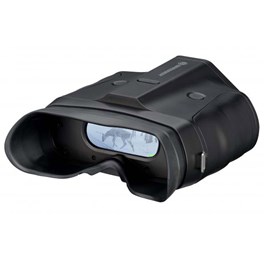
These powerful binoculars with integrated IR lighting offer an impressively sharp and clear level of image quality in the dark – even, in fact, when it’s absolutely pitch black. The Bresser Digital Night Vision 3x20 Binoculars use a 4:3 display to show the image, which is comfortable to use for long periods, and offer 3x-6x magnification levels with a 100m detection range. We also like the padded strap that’s included, which makes them comfortable to use for extended viewing sessions.
Once again, you do need to keep an eye on the batteries – the binoculars are powered by six AAs, which is good for about six hours of viewing. Again, rechargeables are a good idea for cost-saving in the long run. They do come with six batteries in the box though, so the good news is, you have everything you need to get started right away.
Best Sports Binoculars
There are many cases where a pair of binoculars can improve your enjoyment of a sporting event. But as you’ll learn throughout this buying guide, there are many different types of binos that suit differing subjects - sports binoculars are no different. However, if you were to try and pin down an-rounder pair, you’d be looking at 8x42, or a 10x25, for something more portable.

Pros:
- Budget-friendly price
- Compact and very portable
- Waterproof design
Cons:
- You may want more than 8x magnification
Portable and affordable, the Hawke Vantage HD 8x42 binoculars are an ideal choice to take with you for sports viewing. The 42mm objective lens lets in plenty of light, giving you a bright and clear image, and the 8x zoom should be enough for most purposes — though if you know you’re going to be viewing at real distance, you may want to consider the Nikon Sportstar EX 10x25 also featured in this section, which offer a higher 10x magnification.
The lenses have been fully multi-coated to aid light transmission, and the internals have been nitrogen purged for fogproofing. We also like the lightweight design of these binoculars; they weigh in at 595g with a polycarbonate shell, but there’s also rubber armour to protect from impacts and accidental drops. The 17mm eye relief and twist-up eye cups with position stops also mean the Hawke Vantage HD 8x42 binoculars are suitable for use with glasses.
Pros:
- Waterproof (up to 2 m for 5 minutes) and fog-free with O-ring seals and nitrogen gas
- Lightweight, compact and will easily fit in any bag
Cons:
- They do not have the best optical quality but are more than adequate for casual viewing
Just as it sounds, Nikon’s Sportstar EX 10x25 Binoculars are perfectly pitched for sports viewing of all varieties. A 10x magnification is about right for most sports viewing, and the objective lens diameter of 25mm lets a decent amount of light in. Once again, the optics are well-treated, with multilayer coatings for a sharp and accurate image. Nikon’s proprietary Eco Glass makes another welcome appearance, assuring the user that all elements are free from lead and arsenic.
These waterproof binoculars are comfortable to use, with multi-click adjustable eyecups that can be altered to suit eyeglass wearers if needed. The binoculars are slim in profile, with a stylish look and twin-hinged foldable design. O-ring seals ensure that water is kept out, while nitrogen purging means that sudden changes in temperature don’t cause fogging. All in all, this affordable pair of binos delivers just the kind of performance an avid sports fan desires.
FAQs
What makes a pair of binoculars “the best”?
The best binoculars combine bright, sharp optics with a solid, comfortable design. Look for models that balance magnification and field of view, use high-quality glass for clear detail, and feel well-built enough to handle regular use outdoors. The “best” really depends on what and where you’re viewing.
How do I choose the right magnification for binoculars?
Magnification affects how close subjects appear, but higher isn’t always better. For general use, 8x or 10x is ideal – offering a good mix of reach, stability and brightness. Go higher only if you have a tripod or particularly steady hands.
What’s more important – magnification or lens size?
Both matter, but lens size often has the bigger impact on image quality. Larger objective lenses (the front ones) gather more light, giving you brighter, clearer views, especially in low light. Magnification controls how close things look; lens size controls how well you can actually see them.
Are expensive binoculars really worth it?
Often, yes – but only if you’ll notice the difference. Premium binoculars usually offer sharper optics, better coatings, smoother focusing and superior build quality. If you’re outdoors regularly, it’s an investment that pays off in both clarity and comfort.
What’s the best type of binoculars for wildlife and birdwatching?
Look for lightweight, weather-sealed binoculars with good close-focus ability and a wide field of view. These help you track fast-moving subjects and handle damp, unpredictable conditions without fogging up.
What should I look for if I wear glasses?
Choose binoculars with adjustable eyecups and generous eye relief (at least 15mm). This allows you to see the full image without removing your glasses or losing part of the field of view.
How do waterproof and fog-proof ratings affect performance?
These features protect your binoculars from moisture and internal fogging; a must for outdoor or coastal use. Models filled with nitrogen or argon gas and sealed with O-rings will last longer and stay clear even in damp or cold conditions.
How can I tell if binoculars are comfortable to use for long periods?
Comfort comes from a mix of balance, grip and focus feel. Try to hold a few pairs if possible; look for smooth focus action, a shape that fits your hands, and rubber armour that feels secure even when wet. Small ergonomic differences can make a big difference over time.
How do we decide?
Our in-house photography specialists, store staff, and industry partners work together to review our buying guides and advice articles. We also monitor emerging trends and listen closely to customer feedback, ensuring our recommendations stay current and relevant to what photographers and filmmakers are actually looking for.
By carefully curating the products we recommend, our guides are designed to offer clear, trustworthy advice that helps customers choose the right kit with confidence.
If you would like further advice, our contact centre team are here to help. You can also reach us via email or social media. And remember, if you purchase based on our recommendations, your order is covered by our full returns policy.
Sign up for our newsletter today!
- Subscribe for exclusive discounts and special offers
- Receive our monthly content roundups
- Get the latest news and know-how from our experts