A good spotting scope is a trusty field companion for any wildlife enthusiast – especially wildlife photographers. Allowing you to close the viewing distance on elusive wildlife subjects and see them in all their glory, a spotting scope can be an invaluable tool for scouting out wildlife photography sessions, or indeed just enjoying viewing the animals for its own sake.
We’ve picked out here a selection of the best spotting scopes on the market, based on our team’s extensive testing experience in the field. We’ve picked a mixture of types, including angled and straight spotting scopes as well as modular scope systems that can be customised with different accessories, and have also included a budget-friendly option.
Check out our guide to the best binoculars for more wildlife-spotting goodies – and let’s get started with the best of the best spotting scopes.
Best angled scopes

Pros:
- Large objective lens
- Great value for money
- 22-66x zoom range
Cons:
- On the hefty side
The 100mm objective lens on the Celestron Ultima 100 gives it plentiful light-gathering capability, meaning it’s potentially suitable for star-spotting as well as daytime wildlife watching. Priced to appeal to casual users and hobbyists, the Ultima 100 also boasts a generous zoom range, running from 22x all the way to 66x. This gives you a decent amount of spotting flexibility without having to change locations.
The scope is constructed from waterproof rubber armour, allowing it to be used outdoors in all weathers. It has also been nitrogen-purged for fogproofing. Its multi-coated optics deliver very good sharpness – not as good as the scopes that cost twice or three times the amount, but definitely excellent for the price. This is a fairly large scope, tipping the scales at just over 2kg, but those who don’t mind a bit of bulk will be able to enjoy hours of happy viewing.

- Lightweight design with pin-sharp optics
- Waterproof and fogproof
- Comfortable ergonomics for long-term use
Cons:
- An expensive option
The Swarovski name is something of a watchword for quality in optics circles, and accordingly the Swarovski ATS 65 HD Angled Spotting Scope is an outstanding piece of kit. Built to premium standards, inside and out, its body is constructed from aluminium, with green rubber armouring to protect it from water and impacts. The angled eyepiece has been designed with superb ergonomics for comfortable viewing, even over long periods.
Optically, the Swarovski ATS 65 is a diamond. It delivers a rich, punchy image with fantastic clarity and sharp outlines – perfect for spotting wildlife. It’s also nice and lightweight, meaning it won’t add too many grams to your bag if you take it on a long hike to a shooting or spotting location. The interior has been nitrogen-purged to prevent fogging.
While it’s not the cheapest scope, the Swarovski ATS 65 is a superb choice for the discerning spotter who demands the best of the best.

Pros:
- Up to 75x zooming power
- Excellent, crisp image
- Durable build
Cons:
- Fairly heavy
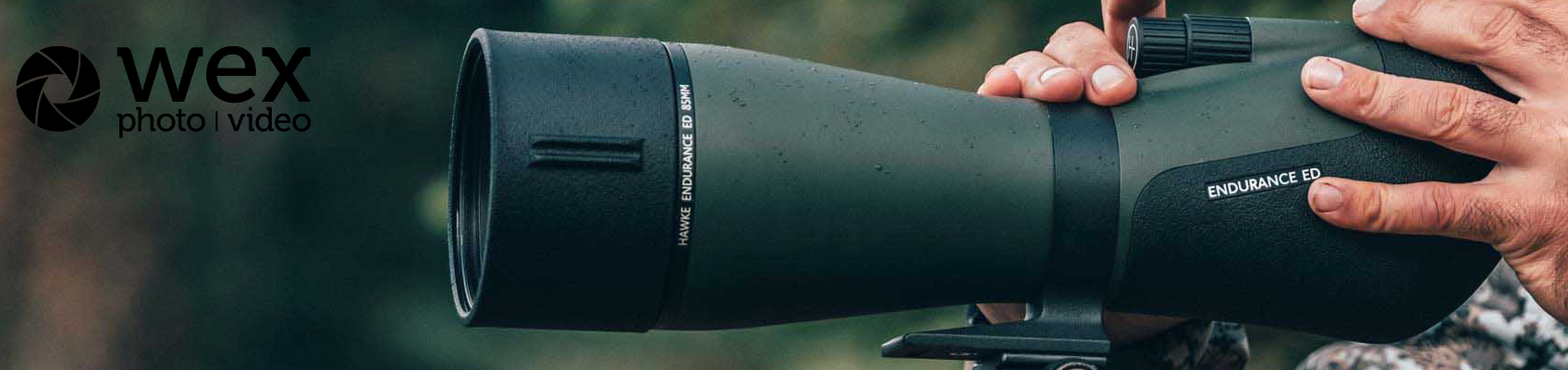
Hawke’s aptly named Endurance scope is designed to go the distance. Constructed with a temperature-resistant, lightweight polycarbonate chassis, the Hawke Endurance ED 25-75x85 Spotting Scope can withstand the rigours of travel and extended outdoor use. It’s waterproof and fogproof, with a positionable eyecup and a tactile dual-focus knob that allows for precise focusing adjustments. The knob is also slip-resistant, and is designed to be operable even when the user is wearing gloves.
The Hawke Endurance ED 25-75x85 delivers an impressive 25-75x zoom range, allowing you to get good and close to your spotting subjects – and what’s more, its optical performance remains consistently excellent right the way through that zoom range. Extra-low dispersion glass ensures top-notch clarity, while BAK-4 Porro prisms boost contrast and produce vivid, intense colours. The large 85mm objective lens means performance is still excellent even in poor light.
At just over 1.8kg, the Hawke Endurance ED 25-75x85 is not as heavy as the Celestron Ultima 100, though is still not what you’d call lightweight.
Best modular scope

Pros:
- Incredible optical detail
- Large 115mm objective lens
- Can take polarising / ND filters
Cons:
- Eyepiece sold separately
- Premium professional price
If you’re looking for the best of the best in terms of spotting scopes, with money no object, then the fabulous Swarovski 115mm Objective Module should be your port of call. This modular spotting-scope system requires separately sold eyepieces – Swarovski offers the BTX, ATX and STX – but delivers an absolutely scintillating level of detail and clarity, thanks to its large 115mm objective lens and pin-sharp optics.
The module itself is constructed from armoured rubber to protect against impacts, and the interior has been nitrogen-purged for fog-proofing. It’s even waterproof, submersible down to depths of 5m, and the sophisticated glass elements of the lenses have been treated with SWAROTOP and SWARODUR coatings to deliver superior light transmission.
Naturally, the premium, pro-level price of the Swarovski 115mm Objective Module and its accessories will mean that it’s not suitable for all users. But if you’ve got the budget, and you want one of the most exceptional modular spotting scopes on the market, it’s right here.
Best straight scope

Pros:
- Tiny dimensions ideal for travel
- Waterproof construction
- Bright lenses for clear viewing
Cons:
- Smaller objective lens than rivals
- Eyepiece sold separately
For a lightweight, travel-friendly scope, the Nikon Fieldscope ED50 Straight is our top recommendation. It weighs just 470g and is very slender and pocketable, especially if you opt for the straight design (there’s also an angled variant). The scope has a 50mm objective lens, which is smaller than many of the other scopes listed here, but still large enough to produce a bright, clear image – bolstered by a set of fully multilayer-coated lenses.
One thing to bear in mind is that the Nikon Fieldscope ED50 Straight doesn’t come with an eyepiece – you’ll need to add one on, with the Nikon 13-40x/20-60x/25-75x MKII Zoom Eyepiece and Nikon 13-30x/20-45x/25-56x MC Zoom Eyepiece both being suitable for use with this scope.
Best budget scopes

Pros:
- Affordable price, with eyepiece included
- Range of objective lens options
- Smooth focusing action
Cons:
- Optical quality not as good as more expensive scopes
- Not nitrogen -purged
Not all of us want to spend four figures on a spotting scope, quite understandably – the Acuter Natureclose ST65B is available in a range of variants, and comes at a very reasonable price. You can get it in 65mm, 80mm and 100mm objective lens options, with the smallest naturally being the cheapest, and it also comes bundled in with an eyepiece, meaning you’ve got everything you need to start viewing in one package – the version specified here comes with an 8-24mm zoom eyepiece, providing an effective magnification of 16-48x.
Sure, you’re not going to get the same level of pin-sharp optical quality as you would from a top-tier Swarovski – and the interior hasn’t been nitrogen-purged for fogproofing. But the Acuter Scope still delivers solid results – and is easy to use, with a smooth focusing action. An ideal starting point for anyone looking to experiment for the first time with spotting scopes.
FAQs
What makes a spotting scope “the best”?
Put simply, it's a matter of sharp optics housed in a durable body with weather sealing. Offering better reach than a monocular, a good spotting scope should allow you to cover a great deal of distance while still being compact enough to fit in a pocket or small bag.
Should I choose a straight or angled spotting scope?
Both design types have their advantages. Straight scopes have the eyepiece positioned in line with the main body of the scope, which makes for a more compact body and a more direct viewing experience; it can be easier to keep track of fast-moving subjects. Angled scopes, as the name implies place the eyepiece at a 45-degree angle, meaning the viewer looks down rather than straight ahead. This can be more comfortable for long viewing sessions, though makes the scope necessarily more bulky.
What’s the best objective lens size for a spotting scope?
Larger objective lenses (the front ones) gather more light, giving you brighter, clearer views, especially in low light. Of course, larger lenses will necessitate a larger scope, which will have an impact on portability. In general, a 50-65mm objective lens will give you good light-gathering ability in a portable scope, while an objective lens of 80mm or larger will provide superior light-gathering performance, at the cost of increased bulk.
What spotting scope eyepiece do I need?
Many spotting scopes have swappable eyepieces, allowing you to configure the zoom range. Giving yourself a broad zoom range improves versatility, allowing you to take a wide view to spot your subject, and then zoom in to home in on it. However, at high magnifications even small movements will be significantly amplified, which can make the subject difficult to keep in view.
Do I need a tripod for a spotting scope?
Not necessarily, but a tripod can make spotting sessions easier and much more comfortable. Wildlife does not turn up on a set schedule, and you may have to spend a considerable amount of time scanning the environment before you spot your subject. A tripod will make that process much easier.
How do we decide?
Our in-house photography specialists, store staff, and industry partners work together to review our buying guides and advice articles. We also monitor emerging trends and listen closely to customer feedback, ensuring our recommendations stay current and relevant to what photographers and filmmakers are actually looking for.
By carefully curating the products we recommend, our guides are designed to offer clear, trustworthy advice that helps customers choose the right kit with confidence.
If you would like further advice, our contact centre team are here to help. You can also reach us via email or social media. And remember, if you purchase based on our recommendations, your order is covered by our full returns policy.
The Wex Blog



Sign up for our newsletter today!
- Subscribe for exclusive discounts and special offers
- Receive our monthly content roundups
- Get the latest news and know-how from our experts