Photography is an art form made up of milestones. As the technologies for making images with light have advanced, it can be awe-inspiring to look back and reflect on how far we have come. From chemicals and papers to modern digital sensors, from shooting back-garden plants to photographing the far-reaches of the cosmos, photography has undergone a simply incredible journey.
And like all journeys, it was made step by step – or in this case, image by image. So, as we celebrate World Photography Day 2026, fast closing in on 200 years since the first photographic images were produced, we’re looking back at some of the most important steps ever taken. Here, for 2026, are 26 iconic images that changed the world, changed photography – that changed everything…
-
View from the Window at Le Gras, 1827
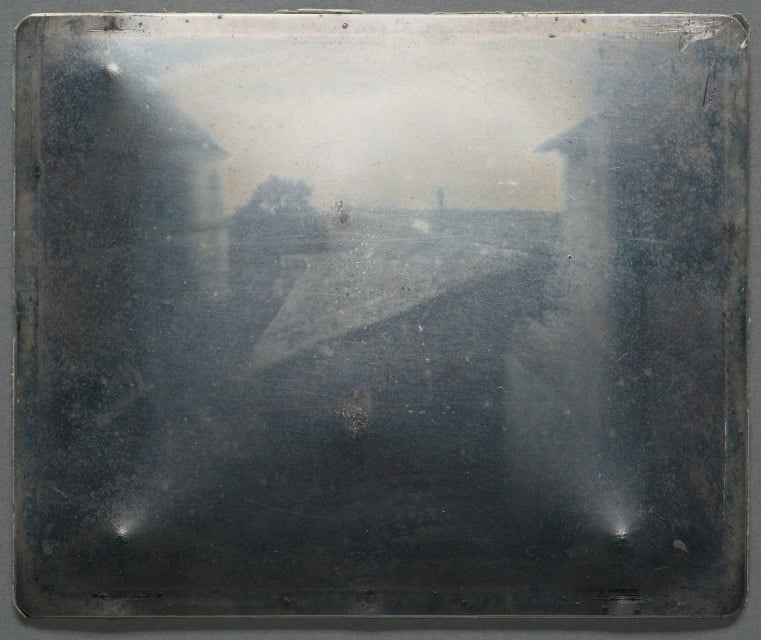
View from the Window at Le Gras, 1827. Photo Credit: Nicéphore Niépce
The image above could quite possibly be the most important on this whole list. It is quite possibly the oldest surviving photograph. Taken on a camera obscura by French inventor Joseph Nicéphore Niépce, who pioneered a photographic technique called heliography, which involved a petroleum by-product called bitumen, mostly used nowadays in road construction.
The image shows a view of the buildings and countryside of Nicéphore Niépce’s estate (he was, somewhat inevitably, a wealthy lad) as seen from a high window. It was captured on a pewter plate coated in bitumen, which hardened in the brightly lit areas, but remained soft and soluble in the darker ones, allowing it to be washed off to create the image.
The exposure undoubtedly took a long time. Estimates have put it from eight hours to as much as several days. Niépce’s name did not become as well-known as the likes of Henry Fox Talbot or Louis Daguerre, in part because he died before these incredible new photographic imaging techniques were revealed to the public. But since then, he has taken his proper place in history’s annals as a true pioneer of the photographic arts – and this image is rightly regarded as one of the most important of all time.
-
Boulevard du Temple, 1838
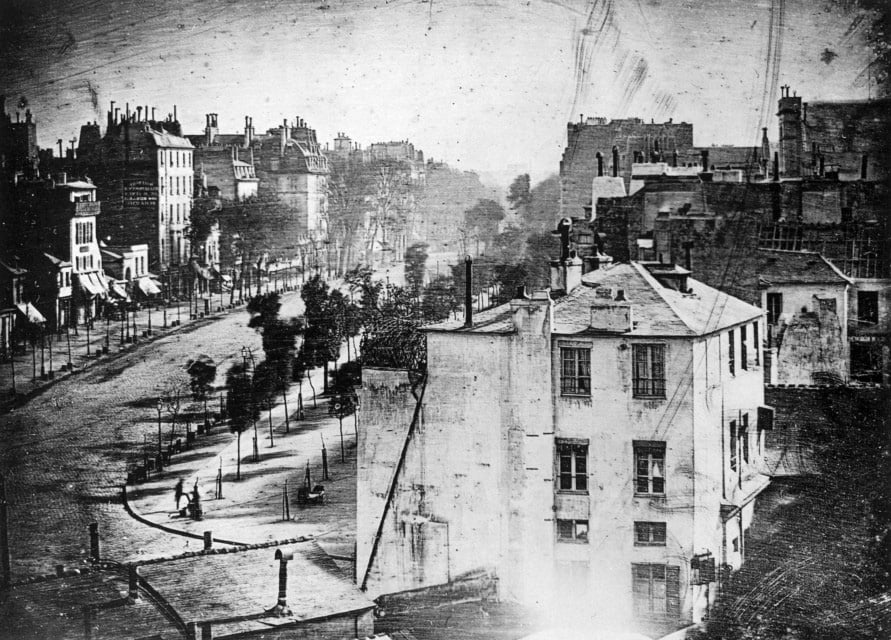
Boulevard du Temple, 1838. Photo Credit: Louis Daguerre
Louis Daguerre, as you likely know, was the inventor of the daguerreotype. This was a type of photographic process that he refined from Niépce’s earlier work – they had collaborated extensively until Niépce’s untimely death in 1833. The image here is one of Daguerre’s earliest surviving daguerreotype plates – however, what’s truly exceptional about this particular image is that it might well be the first photograph of a person.
Daguerre’s exposure of the Parisian scene took ten minutes. This meant that while people, horses, carriages and other moving things did pass in front of his camera, none of them showed up on the final image – with one exception.
Look at the bottom right, at the end of the path lined with trees, and you can see a figure of a man. This man was having his shoes shined during Daguerre’s exposure, and thus, he stayed still long enough to be captured photographically.
-
Robert Cornelius’ self-portrait, 1839
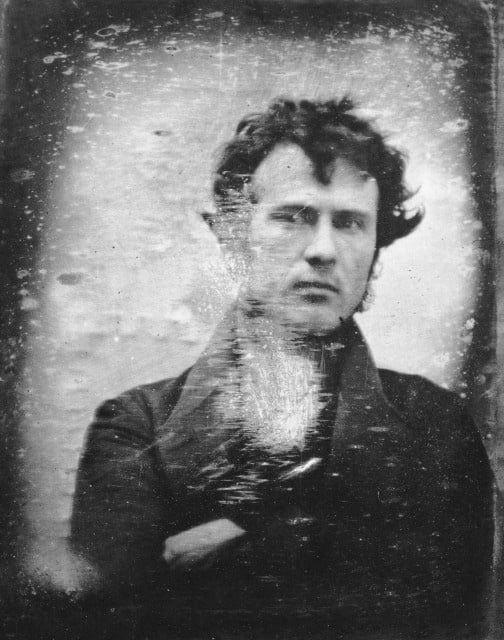
Robert Cornelius Self-Portrait, 1839. Photo Credit: Robert Cornelius
Just one year after Louis Daguerre’s accidental image, American photographic enthusiast Robert Cornelius made history by doing something that nowadays is extremely familiar to all of us – turning the camera around. His self-portrait was the first daguerreotype Cornelius ever captured, using an improvised camera obscura, and was made outside of his family store.
His image was likely not the first photographic portrait ever captured. It was, however, the first selfie, and you’ve got to give old Robbie props for that. It’s a startlingly clear and vivid portrait, too – all the more impressive when you remember that Cornelius would have had to stay still, in that rather rakish pose, for between 10 and 15 minutes to complete the exposure.
-
First image of the sun, 1845
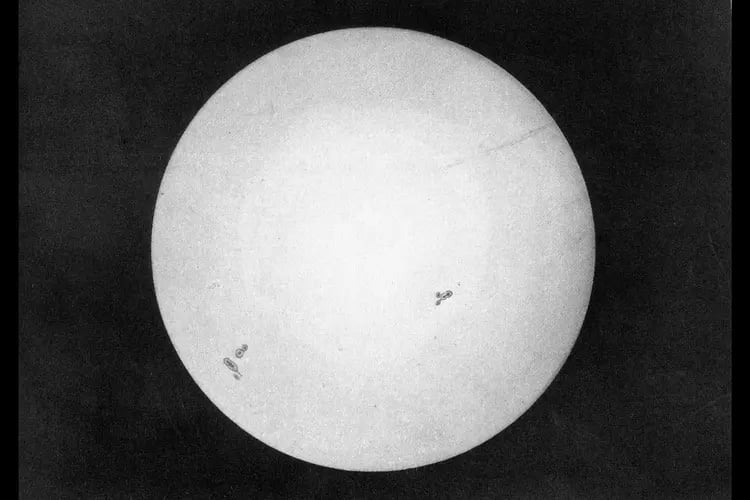
First Photograph of the Sun, 1845. Photo Credit: Hippolyte Fizeau and Léon Foucault
As the daguerreotype technology gained in popularity, more and more people in various fields became eager to see what it could accomplish. French physicists Léon Foucault and Hippolyte Fizeau, who had already made some improvements to the efficiency of the daguerreotype process, pointed a camera towards the sun, and used an exposure of just 1/60sec to capture an image showing sunspots and other hitherto unseen details of our star’s surface.
-
First image of an eclipse, 1851
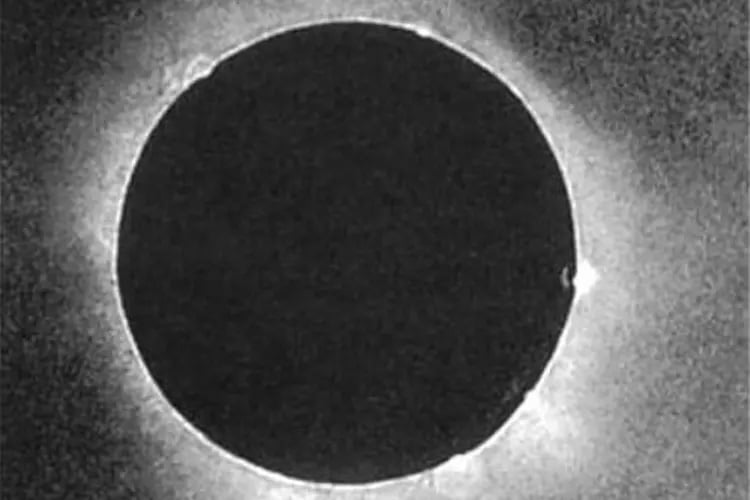
First Photograph of a Solar Eclipse, 1851. Photo Credit: Johann Julius Friedrich Berkowski
Not long after the first image of the sun was taken, photographers were presented with an opportunity. A total solar eclipse was approaching, and so it was inevitable that someone with a daguerreotype and a dream would try their hand at capturing it.
That someone was Prussian-born Johann Julius Friedrich Berkowski, who was commissioned by the Royal Prussian Observatory, and used a small refracting telescope to do what nobody else had yet managed to do, and correctly expose the eclipse’s corona (the ring surrounding the edge).
-
Valley of the Shadow of Death, 1855
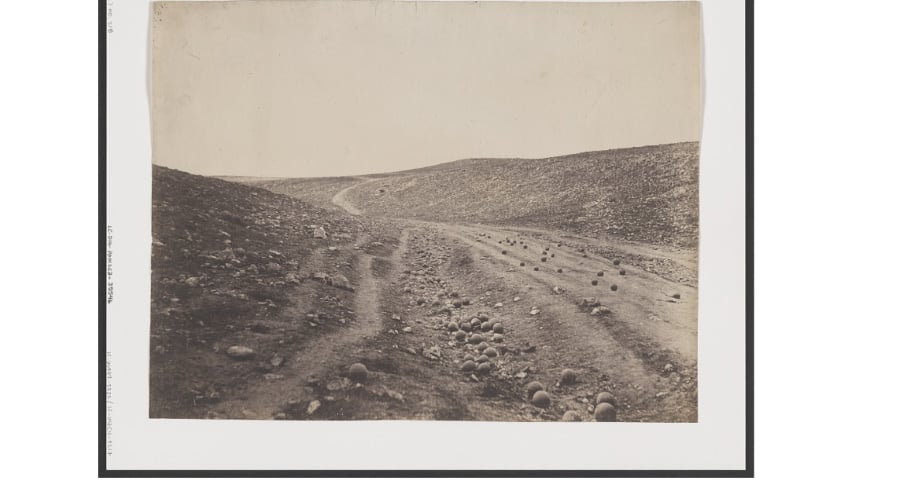
Valley of the Shadow of Death, 1855. Photo Credit: Roger Fenton
Roger Fenton’s images of the Crimean War were not the first war photographs, as daguerreotypes had already been made of the US-Mexican war by this point. However, the images made by Fenton – a British photographic enthusiast who was urged to travel and photograph the war by government ministers – showed such startling artistry that they solidified the idea of war photography in the public mind, and provided a blueprint that is still being followed today.
He photographed the members of the ill-fated Light Brigade, whose deaths were immortalised in poetry by Lord Tennyson, and one of his most famous images took for its title the same Biblical reference that Tennyson used for his poem, Valley of the Shadow of Death, showing discarded cannonballs littering a desolate valley. A stark depiction of the new face of war – industrialised, mechanised.
-
Boston, as the Eagle and the Wild Goose See It, 1860
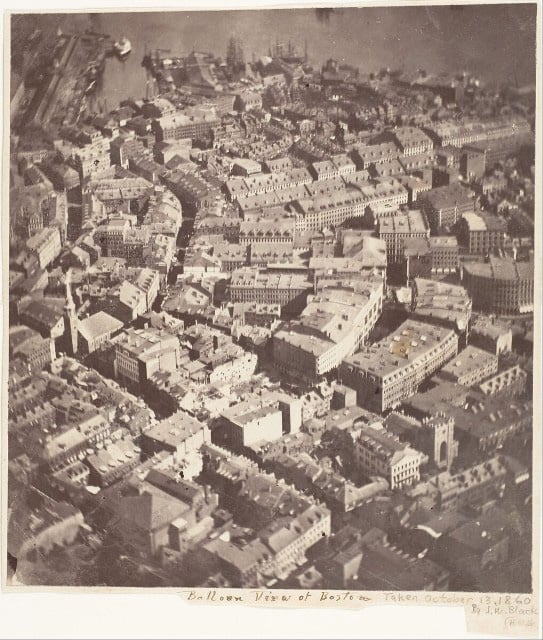
Boston, as the Eagle and the Wild Goose See It, 1860. Photo Credit: James Wallace Black
In the modern era of affordable consumer drones, we’re all quite used to seeing aerial imagery. This was emphatically not the case in 1860, when photographic enthusiast James Wallace Black took to the skies in a hot-air balloon with navigator Samuel Archer King, and created the first aerial images of his home of Boston. He took eight plates of glass negatives, which resulted in just one useable frame – the startlingly beautiful image above.
The following year, the American Civil War broke out. And if you’re wondering how long it took both the Union and the Confederacy to realise the military reconnaissance potential of Black’s aerial photographic techniques, the answer is – no time at all.
-
Tartan Ribbon, 1861
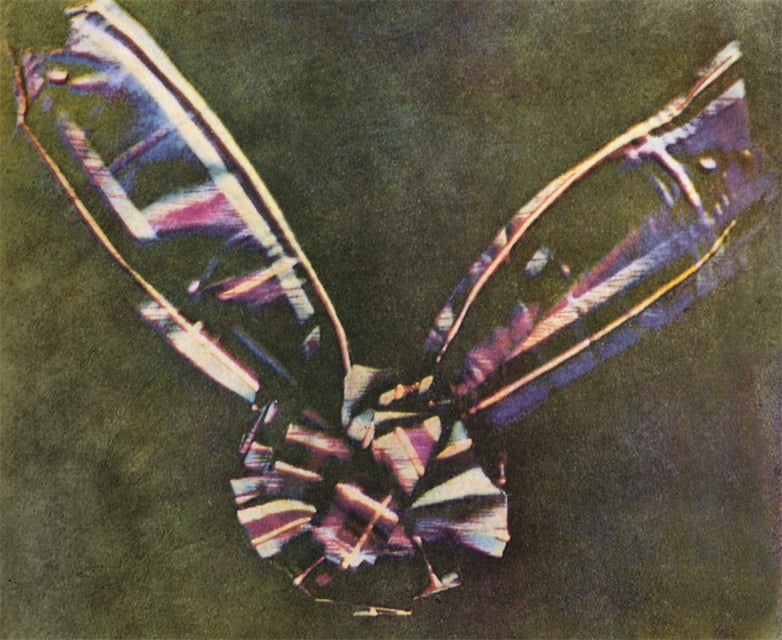
Tartan Ribbon, 1861. Photo Credit: Thomas Sutton / James Clerk Maxwell
By 1861, photographic techniques had been around for a couple of decades, and practitioners were wrestling with the problem of colour. Not just how to capture it, but how to keep it – many successful colour photographs were made using various chemical processes, but their colours would fade rapidly when they were exposed to light.
It was English author and photographer Thomas Sutton who cracked it. Building on a theory proposed by physicist James Clerk Maxwell, Sutton captured three separate exposures of a tartan ribbon through red, green and blue filters. When these developed negatives were projected through lanterns containing filters of the same colours, the resulting combined image appeared to be in colour.
-
The Horse in Motion, 1878
You’ve seen this one. Eadweard Muybridge’s succession of “automatic electro-photographs”, successfully proving that a horse does indeed lift all of its legs off the ground when it gallops. Captured using a battery of 12 cameras, producing tiny negatives with exposures of just 1/1000th of a second, the series was a landmark moment, proving that photography could be used to document things not visible to the naked human eye.
-
Song thrush’s nest, Enfield, 1891
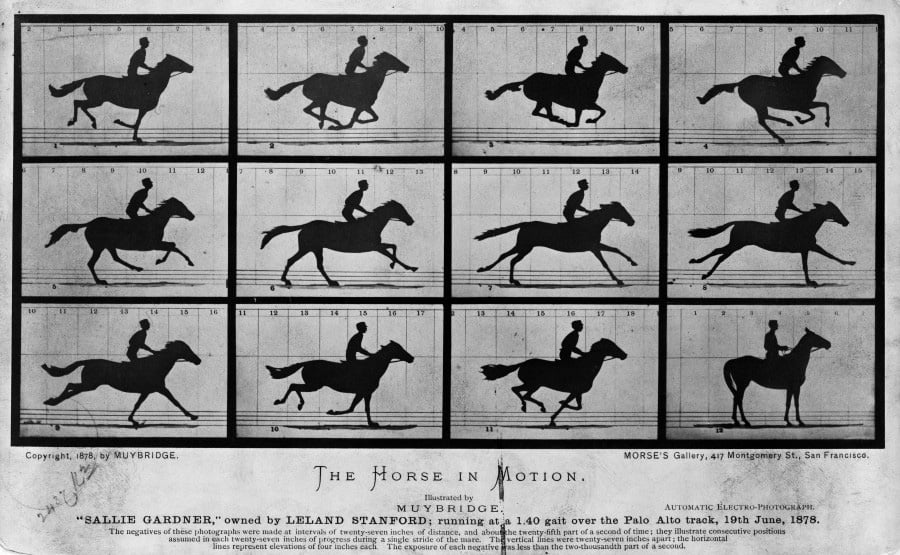
The Horse in Motion, 1878. Photo Credit: Eadweard Muybridge
When British brothers Richard and Cherry Kearton happened upon a bird’s nest with eggs in Enfield, it sparked an interest for both of them in capturing the natural world using the still relatively new and exciting art of photography. Their burgeoning passion resulted in them capturing enough images to fill and publish a book, titled British Birds' Nests: How, Where, and when to Find and Identify Them, and in doing so, made them the first professional wildlife and nature photographers.
-
Grandfather Flash, 1906
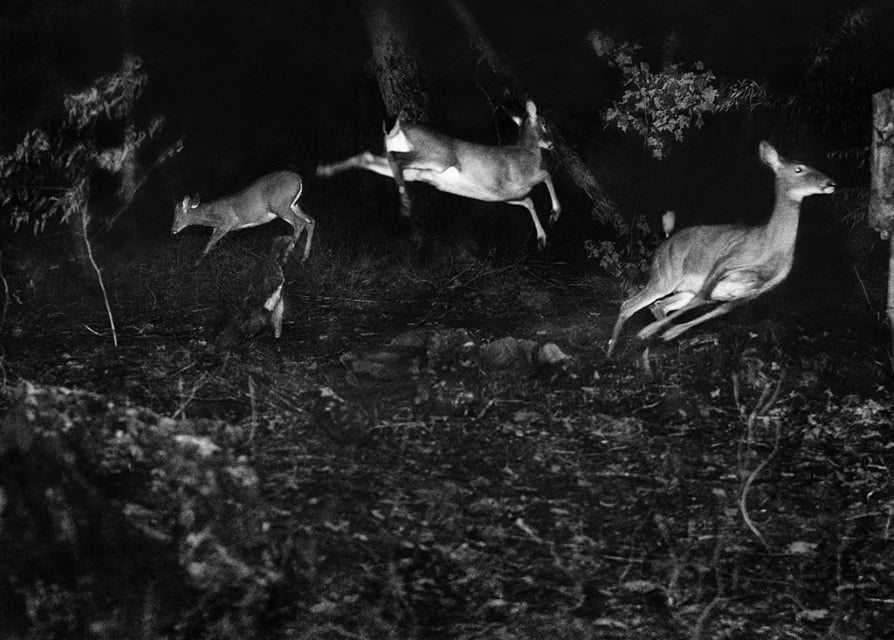
Grandfather Flash, 1906. Photo Credit: George Shiras
Building on what the Keartons had pioneered, US State Representative and keen amateur photographer George Shiras III pushed wildlife photography into something we would find more familiar today. He innovated the use of camera traps and flash photography to capture the natural behaviour of animals in their habitats, and his work was extensively published in National Geographic, a publication that has since bestowed upon him the affectionate nickname, “Grandfather Flash”.
-
The Birth of a Flower, 1910
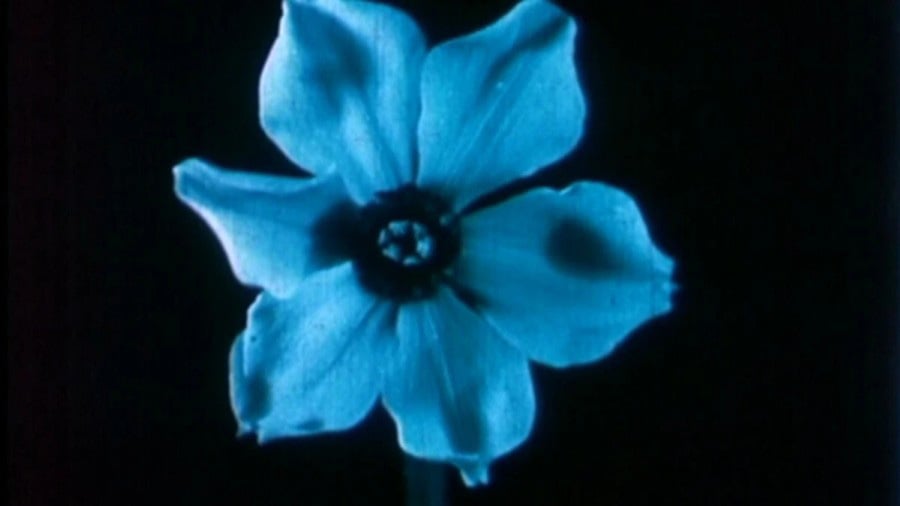
The Birth of a Flower, 1910. Image Credit: F. Percy Smith
Photographer, naturalist cinematographer F. Percy Smith was a lover of all things microscopic – to the point where he actually adopted a pet bluebottle. He worked with extension tubes for lenses to develop new methods of capturing tiny subjects in extreme close-up details, pioneering what we today think of as macro photography. Many of his creations were edited together into time-lapse films, such as his iconic work Birth of a Flower, capturing the simple visual poetry of a flower opening its petals.
-
Lüdenscheid, 1913-14
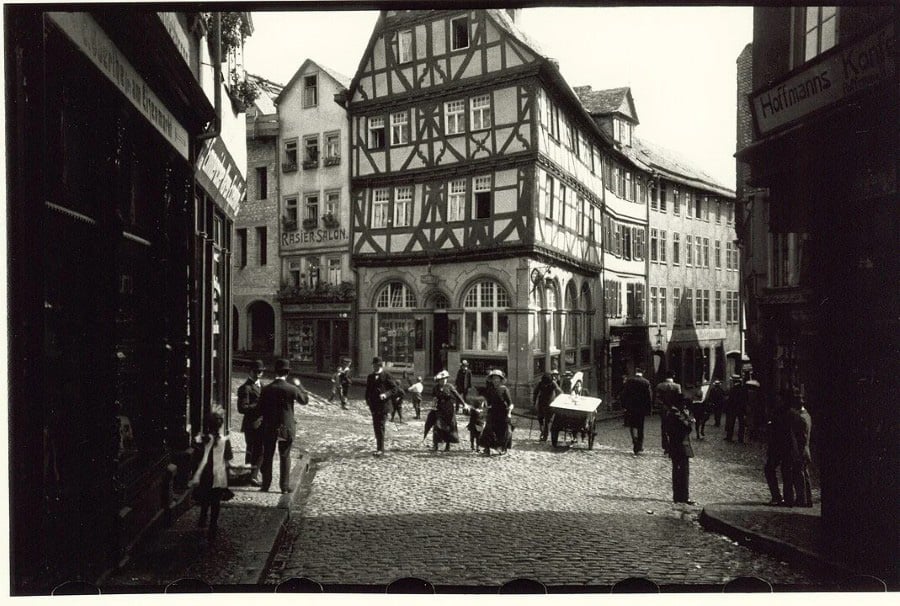
Lüdenscheid, 1913–1914. Photo Credit: Oskar Barnack
This image was captured by Oskar Barnack around 1913-14, while he was testing a smaller, lighter type of film camera he was developing, called the Ur-Leica. It used 35mm cine film, advancing it horizontally to create 24x36mm negatives, and the eventual camera that resulted, the Leica I in 1925, was eagerly embraced by journalists looking for something more lightweight than the ponderous, large-format cameras of the time. And so, more than a century of photographic history was made – with Leica cameras still beloved by photographers today.
-
The first photograph from space, 1946
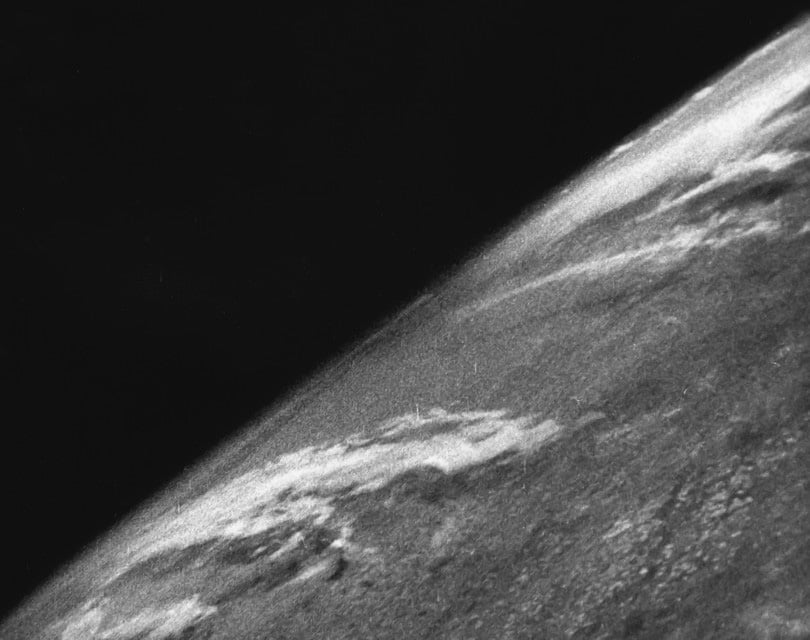
The First Photograph from Space, 1946. Image Credit: Clyde Holliday
You have to wonder if the likes of Joseph Nicéphore Niépce or Louis Daguerre ever imagined this. More than one hundred years after the first photographic images were created, the V-2 No. 13 suborbital spaceflight from the US captured a sequence of images that represented the first photographs of the Earth to be taken from outer space. Better, clearer images would follow – but these were first.
-
First digital photograph, 1957
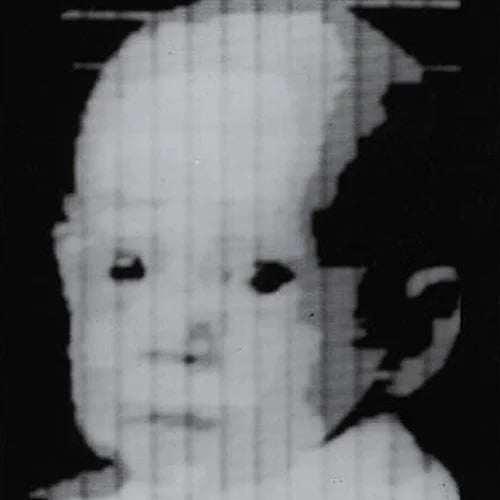
First Digital Photograph, 1957. Image Credit: Russell Kirsch
While digital imaging sensors were still a few years away, the first digital photograph was created earlier than you might have thought – by American engineer Russell Kirsch, when he used a digital scanner he had been working on to digitise an image of his three-month-old son. With dimensions of 176 x 176 pixels, it was a far cry from the ultra-high-resolution digital images we see as standard today; indeed, its low resolution was partly due to the fact that the computers available simply weren’t capable of storing much more information than this.
-
Earthrise, 1968
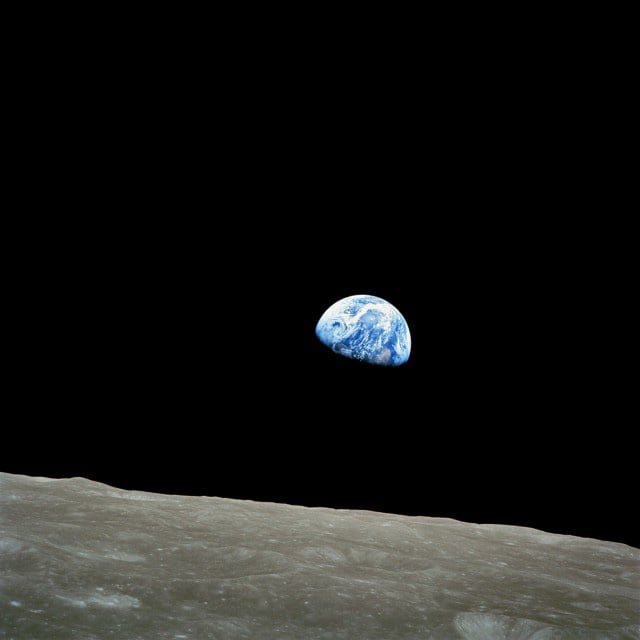
Earthrise, 1968. Photo Credit: William Anders / NASA
Now, here’s a philosophical debate for you. Does Earthrise, an image captured by Apollo 8 astronaut William Anders while in orbit around the moon, and the first image to be captured of the Earth from space by a person rather than a probe or other autonomous device, contain any people?
Well, in one sense no; there are clearly no human beings visible in that image. But in another sense, yes, it contains every single human being who was alive at the time. Arguably it contains the constituent matter of every single human being who had ever lived up to that point, and probably every human being who ever will live.
Except for one.
-
Buzz Aldrin, 1969
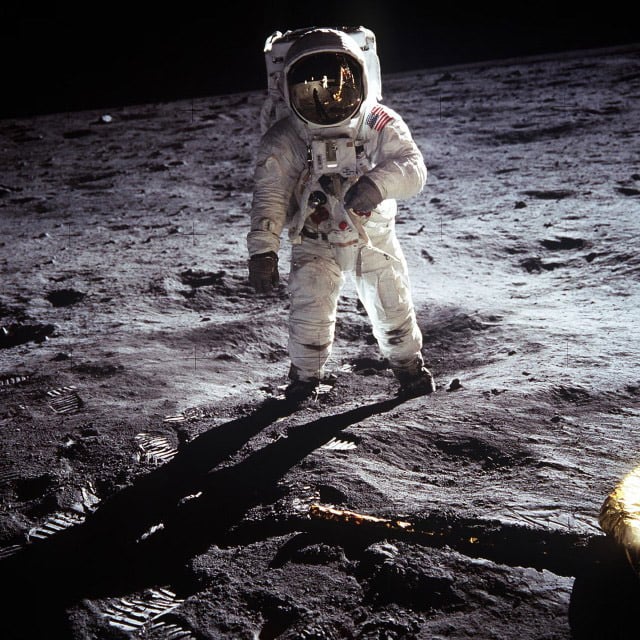
Buzz Aldrin on the Moon, 1969. Photo Credit: Neil Armstrong / NASA
When you think of Neil Armstrong, the first word that springs to your mind isn’t necessarily “creativity”. And yet, this image of fellow astronaut Buzz Aldrin that Armstrong captured standing in the Sea of Tranquility displays a real sense of artistry. Aldrin’s face is obscured by his visor, but Armstrong and his camera are perfectly framed in the reflection.
Oh, yes, and also, it’s one of the first images taken from the surface of the moon, a seminal moment in human history, blah blah blah. But seriously. Look how good it is!
-
“Needs work,” 1975
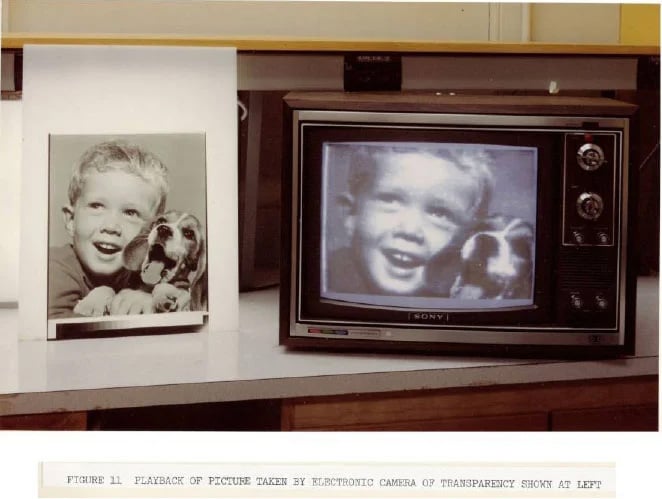
Needs Work, 1975. Image Credit: Steven Sasson / Eastman Kodak Company
Now, the image above isn’t technically the image I want to talk about. That one has not survived. Steve Sasson, an engineer at Kodak, was toying with something called a charge-coupled device. He’d created a camera the size of a toaster that he was convinced could be used to capture images electronically, without the need for chemicals and film. The first image he captured was of a colleague, a technician named Joy Marshall, who obligingly posed for Sasson’s strange-looking device.
The resulting image was not a success. Marshall’s hair was captured, but her face was obscured by static. Seeing the result, her pithy response before disappearing back to her own lab was: “Needs work.”
Sasson did put in the work, and was able to create a device that produced a digital image that could be displayed on a television screen. His device became known as a CCD sensor, and was the standard for digital cameras for years, before ultimately being superseded by the CMOS sensors we use today.
-
Jennifer in Paradise, 1987

Jennifer in Paradise, 1987. Photo Credit: John Knoll
John Knoll was a technician at Lucasfilm’s visual effects house Industrial Light & Magic, better known as ILM. While playing around with the company’s new piece of image-manipulation hardware – the Pixar Image Computer that would go on to be the central pillar of the phenomenally successful animation studio – Knoll became fixated on the idea that a cheaper, easier-to-run version of the machine’s software could be used as an at-home photo-editing platform.
Working with his brother Thomas, a computer scientist, Knoll developed an application that could run on a Macintosh Plus. While looking for images that could be used to display what his new program could do, he uploaded a scan of a print he’d taken of his wife relaxing on a beach in Tahiti. It was the first colour image to be used to demonstrate the capabilities of Knoll’s program – which he had named “Photoshop”.
-
Pale Blue Dot, 1990
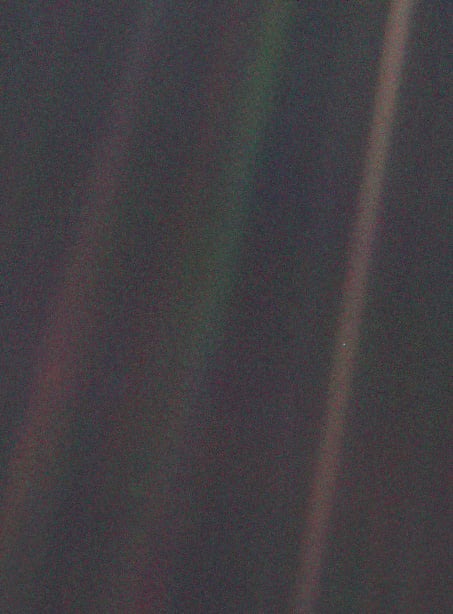
Pale Blue Dot, 1990. Image Credit: NASA/JPL-Caltech
Just as Robert Cornelius made history by turning the camera to face himself, so too did astronomer and author Carl Sagan, by suggesting to NASA that the Voyager 1 space probe be used to capture an image of Earth from more than six billion kilometres away, as it exited our solar system. The resulting image reduces our whole planet, and all the hopes, dreams, lives, deaths, empires, homes, achievements and failures to a minuscule, barely perceptible dot amid the infinity of everything else.
I can’t really improve on what the man himself said about this image, so here is Carl Sagan:
“Consider again that dot. That's here. That's home. That's us. On it everyone you love, everyone you know, everyone you ever heard of, every human being who ever was, lived out their lives. The aggregate of our joy and suffering, thousands of confident religions, ideologies, and economic doctrines, every hunter and forager, every hero and coward, every creator and destroyer of civilization, every king and peasant, every young couple in love, every mother and father, hopeful child, inventor and explorer, every teacher of morals, every corrupt politician, every ‘superstar’, every ‘supreme leader’, every saint and sinner in the history of our species lived there – on a mote of dust suspended in a sunbeam.”
-
Les Horribles Cernettes, 1992
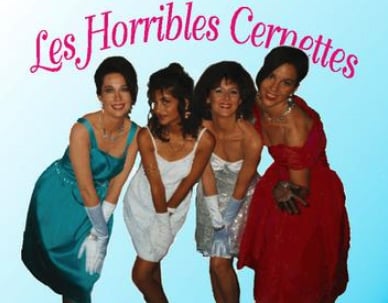
Les Horribles Cernettes, 1992. Photo Credit: Silvano de Gennaro
This image, as you no doubt can see because you have eyes, is completely unremarkable. It’s a photograph of a singing group comprising four employees of CERN, the research facility for nuclear science and particle physics. It contains some pretty heinous WordArt. It’s not very big.
However, this image earns its place in history because it is the first image uploaded to the World Wide Web. CERN analyst and keen amateur photographer Silvano de Gennaro was asked by his mate Tim Berners-Lee for some scanned photos to upload to a project Berners-Lee was working on. De Gennaro passed him via FTP some images he’d taken of his girlfriend’s workplace doo-wop group on his Canon EOS 650D, which Berners-Lee uploaded.
And now, every photo you’ve uploaded to Instagram, every image you’ve hosted on a website, every photo we’ve published to this blog… all of it exists downstream of Les Horribles Cernettes.
-
First camera phone photo, 1997
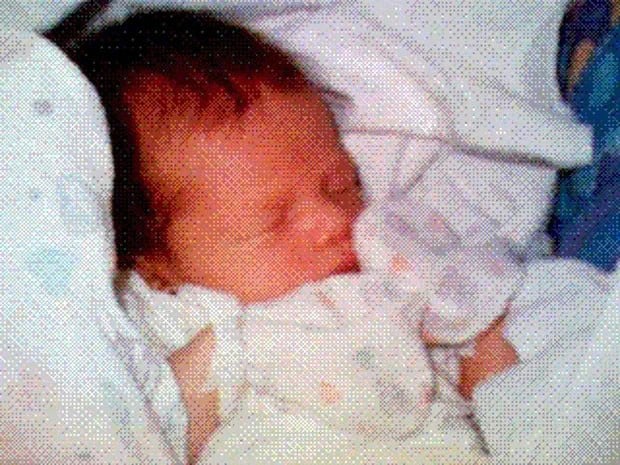
First instantly shared camera phone photo, 1997. Photo Credit: Philippe Kahn
Just like the first digital image, the first phone photo was taken earlier than you might have thought. French engineer Philippe Kahn had hacked together a primitive camera phone by combining his digital camera and his mobile, and he used it to capture a picture of his newborn daughter. He didn’t know this at the time, but he was defining what the next few decades of photography would look like, and his simple image has since been hailed as one of the most influential and important of all time.
-
test, 2010
View this post on Instagram
With this single image of a stray golden retriever, photographers everywhere were cursed. All the complaining you’ve ever seen about Instagram’s algorithm, all the silly follow-unfollow games, all the hashtags, all the endless self-promo and obsessing over likes and follower counts – all of it started here, with the first photo ever uploaded to Instagram. It was uploaded by the platform’s co-founder, Kevin Systrom, and simply captioned “test”.
-
Monkey selfie, 2011
First instantly shared camera phone photo, 1997. Photo Credit: Philippe Kahn
More than 100 years after the Kearton brothers pioneered nature photography, nature photography pioneered itself. A crested macaque picked up the camera of wildlife photographer David J. Slater, and managed to capture a selfie. Not only did the shot go stratospherically viral – it sparked a multi-year, still-simmering debate about the nature of a photograph’s copyright.
Photo copyright law is mostly pretty simple: the person who took the photo generally owns the copyright. So what happens when the person is a monkey? Animals can’t hold copyright. But Slater was the photographer present – he set up the shot, and it was captured on his equipment. Nevertheless, publications eager to capitalise on a viral trend jumped on the chance to splash the photo everywhere. The debate has never been truly settled, and indeed, has been reignited as the proliferation of AI imaging tools has opened up new questions regarding photographers and copyright.
-
First photo of a black hole, 2019
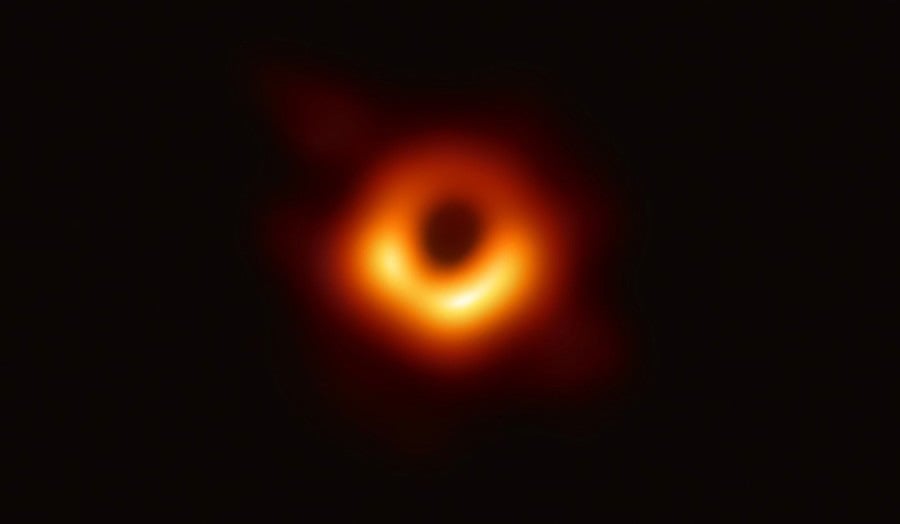
First Image of a Black Hole, 2019. Image Credit: Event Horizon Telescope Collaboration
It may be blurry, it may be indistinct, but this image represents an astounding technological achievement. Captured by NASA using the Event Horizon Telescope, it is the first ever image taken of the black hole at the centre of our galaxy, framed by the hot gases that swirl around the inexorable gravity of its event horizon.
-
Perseverance, 2021
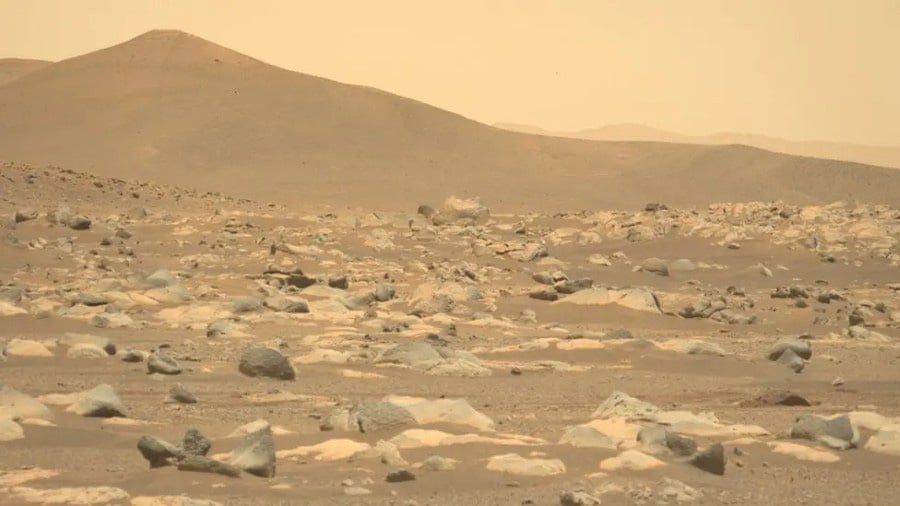
Perseverance Rover’s First Image from Mars, 2021. Image Credit: NASA/JPL-Caltech
And finally, we have the first images taken from the surface of another planet – not just a satellite of ours, but a whole other world. The Perseverance rover touched down on the surface of the Red Planet in 2021, and since then has been busily transmitting back breathtaking images from its landing site and beyond, as it continues its search for microbial life on other worlds. And if it finds it – the search is ongoing – an image resulting from that might just be more incredible than anything we’ve seen already.
About the Author
Jon Stapley is a London-based freelance writer and journalist who covers photography, art and technology. When not writing about cameras, Jon is a keen photographer who captures the world using his Olympus XA2. His creativity extends to works of fiction and other creative writing, all of which can be found on his website www.jonstapley.com
Trending Articles
Sign up for our newsletter today!
- Subscribe for exclusive discounts and special offers
- Receive our monthly content roundups
- Get the latest news and know-how from our experts