
Whether you’re using a Nikon DSLR or mirrorless camera, these are the best Nikon lenses to buy. We’ve put together a tempting list of Z-mount and F-mount lenses, for all different purposes and at a range of price points, to help you upgrade your Nikon kit and get better shots.
Bear in mind that you’ll need to factor in sensor size, as Nikon’s DSLRs and mirrorless cameras both offer full-frame and APS-C models, which Nikon refers to as FX and DX respectively. DX lenses are only suitable for DX bodies; FX lenses will work with either, though the field of view will be cropped, and they also may not balance too well with the lighter camera.
We’ve picked out a range of great Nikon lenses for different purposes, and have made sure to include options suited to a range of budgets. The lenses on this list are very different, but the one thing they all have in common is that they have truly impressed our team, and they take great shots!
Best Mirrorless Lens
Here are our picks of top lenses to buy for Nikon’s mirrorless Z system. Featuring some absolutely outstanding glass, the Nikon Z system of lenses provides a selection of professional and affordable optics for full-frame and APS-C cameras in the range. This isn’t a comprehensive selection of lenses – just a round-up of our team’s particular favourites. And, we’ve included some third-party options as well as lenses made by Nikon.
|
Pros:
Cons:
|
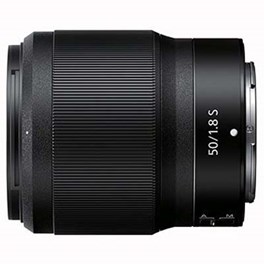
Maximum Aperture: f1.8 Minimum Focus Distance: 0.4m Maximum Magnification: 0.15x Lens Construction: 12 elements in 9 groups (incl. 2 ED and 2 aspherical) Weight: 415g |
Let’s start with something straightforward – and affordable! This is one of the most reasonably priced lenses for the Z mount at the moment, and happily it’s also one of the most useful. When mounted to a camera with a full-frame sensor, the Nikon Z 50mm f1.8 S provides roughly the equivalent to the field of view of a human eye. This makes it perfect for general-purpose photography and capturing things in a naturalistic way – street and documentary shooters should find it useful. All this is bolstered by the f1.8 maximum aperture, which allows for the creation of shallow depth of field and vivid bokeh.
|
Pros:
Cons:
|
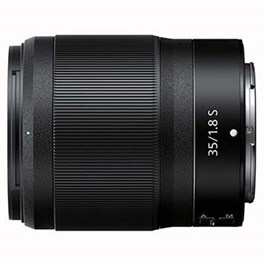
Maximum Aperture: f1.8 Minimum Focus Distance: 0.25m Maximum Magnification: 0.19x Lens Construction: 11 elements in 9 groups (incl. 2 ED and 3 aspherical) Weight: 370g |
A wider prime, well suited to landscapes and architecture shooting, the Nikon Z 35mm f1.8 S boasts edge-to-edge sharpness thanks to a sophisticated internal optical design, and it particularly excels at rendering “point” light sources, i.e. distant small lights of the kind you might see in night-time landscapes. Autofocus is fast and accurate, as you’d expect from a nippy mirrorless system lens, and the body is built to be resistant to dust and drips, standing you in good stead for an outdoor shoot.

|
Pros:
Cons:
|
Maximum Aperture: f1.8 Minimum Focus Distance: 0.8m Maximum Magnification: 0.12x Lens Construction: 12 elements in 8 groups (incl. 2 ED) Weight: 470g |
This is definitely a good choice if you’re planning to shoot portraits with your Nikon Z camera – the short telephoto focal length of the Nikon Z 85mm f1.8 S is ideal for flattering your subjects and making them look as good as possible. The f1.8 maximum aperture also means you can create the kind of shallow depth of field that’s essential for good portraiture, and the minimum focal distance is just 0.8m, in case you want to get really close. Anti-reflective Nano Crystal Coat and a smooth, silent multi-focusing system round out a seriously well-featured lens.
|
Pros:
Cons:
|
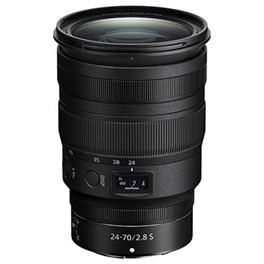
Focal Range: 24–70mm Maximum Aperture: f2.8 (constant) Minimum Focus Distance: 0.38m Maximum Magnification: 0.32x (at 70mm) Weight: 805g |
Covering the workhorse focal range beloved by professionals worldwide, the Nikon Z 24-70mm f2.8 S is designed for those who are really planning to put their Nikon Z camera through its paces. As well as offering ultra-sharp performance, it’s also designed to be extensively customised to just the way you like to work, with a control ring that can be set to cover your preferred function, as well as a function button with 21 different assignable options. It’s built tough, too, with plenty of weather sealing, so wherever the next challenge takes you, the Nikon Z 24-70mm f2.8 S will be able to keep up.
|
Pros:
Cons:
|
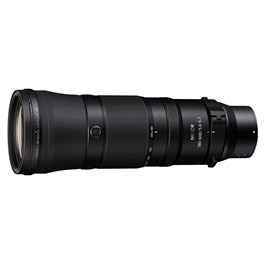
Focal Range: 180–600mm Maximum Aperture: f5.6–6.3 Minimum Focus Distance: 1.3m (at 180mm) Maximum Magnification: 0.25x Optical Stabilisation: VR rated to 5.5 stops |
Look, this is a big old lens. That is quite simply baked into the premise; a small 180-600mm telephoto for a full-frame system is not something that exists, or will exist. But if you can handle a sizeable lens, the Nikon Z 180-600mm f5.6-6.3 VR Lens is an absolutely incredible performer, delivering dazzling imagery across its zoom range, and offering a heap of features that make it easier to use.
The highly effective VR stabilisation powers a ‘SPORT’ mode, which stabilises the image in the viewfinder to make it easier to frame up and find your perfect composition while the action moves around you. The variable aperture is plentifully wide enough to achieve shallow depth of field and separate subject from background, while the nine-bladed aperture delivers beautiful bokeh. This is a brilliant lens for upping your hit rate, and coming away from sporting events or wildlife shoots with an abundance of crisp, sharp, punchy images.
|
Pros:
Cons:
|
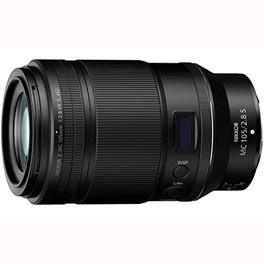
Maximum Aperture: f2.8 (f4.5 at 1:1 magnification) Minimum Focus Distance: 0.29m Maximum Magnification: 1.0x (life-size) Optical Stabilisation: VR rated to 4.5 stops Weight: 630g |
This spectacular macro lens should be the first port of call for anyone shooting close-ups and tiny subjects on Nikon Z-mount cameras. The Nikon Z MC 105mm f2.8 VR S is a wonderful lens, delivering spectacular image quality with a true macro 1:1 reproduction ratio. The minimum focus distance is 29cm, allowing you to press in super-close to your subjects, and the sophisticated optical assembly effectively suppresses distortion, aberration and colour fringing.
Like many high-end macro lenses, the Nikon Z MC 105mm f2.8 VR S also doubles up as a capable telephoto, particularly for portraiture. It’s highly versatile, with a fast internal focusing system and a 62mm filter thread. It also makes a great choice for food photography, the large maximum aperture and telephoto focal length making it easy to throw out backgrounds for beautifully shallow depth of field.
Best DSLR Lens
Here, we’ve collated a selection of our favourite lenses for Nikon’s venerable F-mount DSLR range. While new lenses aren’t really being developed for this range, it includes a huge selection of stone-cold classics and you could spend a happy photo-taking life shooting entirely on F-mount – many people have. And remember that these lenses can easily be converted to work with mirrorless Z-mount cameras via the FTZ adapter.
|
Pros:
Cons:
|
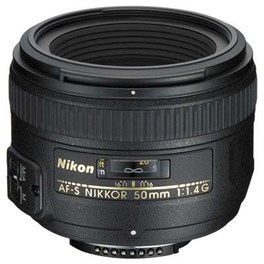
Maximum Aperture: f1.4 Minimum Focus Distance: 0.45m Maximum Magnification: 0.15x Diaphragm Blades: 9 (rounded) Weight: 280g |
This fast lens is a great all-purpose optic for your Nikon DSLR camera. It covers a field of view similar to that of a human eye, making it great for street and documentary work, while its f/1.4 aperture gives it a real edge in low light. Also, if you mount it on a DX-format camera you’ll get a focal length of about 75mm, which makes it a good choice for portraiture. However you choose to use it, you’ll find the Nikon 50mm f1.4 G AF-S Lens to be a stalwart companion you’ll want in your kit bag every time.
|
Pros:
Cons:
|
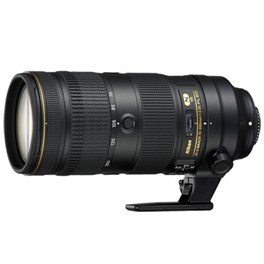
Focal Range: 70–200mm Maximum Aperture: f2.8 (constant) Minimum Focus Distance: 1.1m Maximum Magnification: 0.21x Optical Stabilisation: VR rated to 4 stops |
If you need a solid workhorse lens with a large aperture to work with, then consider Nikon’s 70-200mm, which has an f/2.8 maximum aperture that extends right the way through its zoom range. Made with superior internal optics and boasting Nikon’s Vibration Reduction system for effective image stabilisation, the Nikon 70-200mm f2.8E AF-S FL ED VR Nikkor Lens is a trusty lens that will acquit itself well in all manner of different shooting situations.
|
Pros:
Cons:
|
Maximum Aperture: f3.5 (f5 at 1:1 magnification) Minimum Focus Distance: 0.286m Maximum Magnification: 1.0x (life-size) Optical Stabilisation: VR rated to 3 stops Weight: 355g |
Finally, we have a macro lens for DX-format in a useful mid-telephoto focal length. The fact that this is a prime lens means it has an optical construction that ensures fantastic optical quality throughout images, and a 1:1 reproduction ratio for astonishingly lifelike close-up images. With the Vibration Reduction system present and correct, this lens is fantastic to use handheld, ensuring a top-notch all-around shooting experience.
FAQs
What type of Nikon lens is best for portrait photography?
For portrait photography, prime lenses with focal lengths of 50mm to 85mm are ideal. These lenses offer a wide aperture, allowing for a shallow depth of field and beautiful background blur.
Which Nikon lens should I use for landscape photography?
Wide-angle lenses, ranging from 14mm to 35mm, are perfect for capturing expansive landscapes. These lenses allow you to include more of the scene in your frame and often provide sharp details across the image.
What is Nikon's VR (Vibration Reduction)?
Nikon's VR (Vibration Reduction) lenses reduce camera shake, enabling sharper images in low light and at slower shutter speeds. This feature is especially useful when shooting handheld and when using telephoto lenses.
Are Nikon zoom lenses good for wildlife photography?
Yes, Nikon's telephoto zoom lenses, with focal lengths extending to 300mm or more, are excellent for wildlife photography. They allow you to get close-up shots of distant subjects without disturbing them.
What makes Nikon lenses unique compared to other brands?
Nikon lenses are known for their superior build quality, advanced optical technologies, and innovative features like Nano Crystal Coating for reducing ghosting and flare. Additionally, Nikon's extensive range of lenses ensures that photographers can find the perfect lens for any type of photography.
How do we decide?
Our in-house photography specialists, store staff, and industry partners work together to review our buying guides and advice articles. We also monitor emerging trends and listen closely to customer feedback, ensuring our recommendations stay current and relevant to what photographers and filmmakers are actually looking for.
By carefully curating the products we recommend, our guides are designed to offer clear, trustworthy advice that helps customers choose the right kit with confidence.
If you would like further advice, our contact centre team are here to help. You can also reach us via email or social media. And remember, if you purchase based on our recommendations, your order is covered by our full returns policy.
The Wex Blog



Sign up for our newsletter today!
- Subscribe for exclusive discounts and special offers
- Receive our monthly content roundups
- Get the latest news and know-how from our experts