

Our guide to the best affordable Canon lenses is here to help you enjoy photography on Canon kit without spending a packet. As the cost of living continues to rise, it’s getting harder for all of us to find cash for our hobbies. So, this guide is here to help you find a great, affordable lens for your Canon DSLR or mirrorless camera. Whether you want to shoot landscapes, portraits, wildlife, vlogs or whatever else, there’s a lens on this list that’ll help you do it for a budget-friendly price.
We’ve picked ten affordable lenses for both RF and EF mounts, with options for full-frame and APS-C. We’ve aimed to cover the spread of wide-angle to standard and telephoto, with a mix of primes and zooms. Most of these lenses come under £499 — some are little more, and others are considerably less. There’s a lens on this list that costs less than £20!
So, let’s get into it, and count off the ten best affordable lenses for Canon cameras.
|
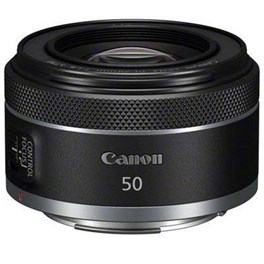
Aperture: f1.8 maximum Minimum Focus Distance: 30cm Weight: 160g Lens Construction: 6 elements in 5 groups Filter Compatibility: 43mm |
Pros:
Cons:
|
The long-awaited mirrorless successor to Canon’s famous nifty-fifty for EF-mount DSLRs, the Canon RF 50mm f1.8 STM is a lens that pretty much any EOS R user should consider for their kit bag. Incredibly light, it boasts redesigned optics that have improved sharpness compared to the DSLR version, and it’s hugely impressive just how sharp Canon have made a lens at this price point. Stop down to f5.6 or f8 for the sharpest results, or whack it wide open to f1.8 for shallow depth of field and dreamy bokeh.
The 50mm focal length provides a naturalistic perspective, neither too tight nor too wide, and is perfect for walking around and capturing everyday scenes. The stepping motor ensures that focusing is quick, accurate and near-silent, meaning the lens excels at street photography. Some may quibble with aspects of the physical design – the plasticky body in particular – but if you want a cheap lens that only weighs 160g, that’s the trade-off you have to make.
|
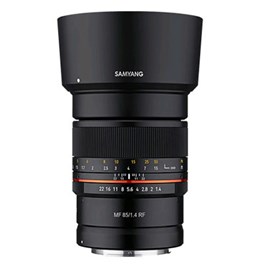
Aperture: f1.4 maximum Minimum Focus Distance: 1m Weight: 730g Lens Construction: 9 elements in 7 groups Filter Compatibility: 72mm |
Pros:
Cons:
|
Now that Canon has started to relax its policy a little around third-party development for its RF-mount, you’re no longer restricted to manual focus only if you want to use a non-Canon lens on a Canon mirrorless camera. However, these manual focus lenses still offer tempting value for the budget-conscious photographer who isn’t fussed about AF.
Portrait lenses are a great candidate for manual AF lenses, since you tend to have the luxury of time to fine-tune your focus without worrying that your subject will run away. Hitting the 85mm sweet spot for portraiture, the Samyang MF 85mm f1.4 creates beautiful bokeh thanks to its eight-blade diaphragm and f1.4 maximum aperture. For throwing the background out of focus, or working in low light, it’s a dream of a lens. It’s robustly constructed too, with a weather-sealed chassis, and while this does add to the overall weight of the lens, it’s great for getting peace of mind while shooting outdoors.
|
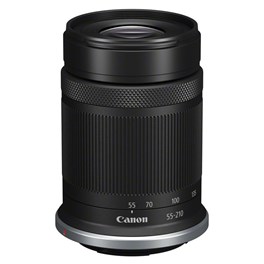
Aperture: f5-7.1 maximum Minimum Focus Distance: 73cm Weight: 270g Lens Construction: 11 elements in 8 groups Filter Compatibility: 55mm |
Pros:
Cons:
|
This isn’t the cheapest RF lens for APS-C cameras – that honour belongs to the RF-S 18-45mm f4.5-6.3 IS STM. However, if you already have an APS-C EOS R camera like the EOS R50 or EOS R10, it’s quite likely you already have that lens, as it tends to be the one bundled in as part of the standard starter kit. So, we’ve instead opted for the Canon RF-S 55-210mm f5-7.1 IS STM as our pick.
Canon’s RF-S lens range is still a little thin, so it’s nice to see a lens as versatile as this for APS-C users, particularly as the range of cameras expands rapidly with new models like the EOS R100. A superzoom can be a challenge to use, but the sophisticated stabilisation system on the RF-S 55-210mm f5-7.1 IS STM is enormously helpful – when combined with a camera’s IBIS system, it can deliver up to seven stops of effective compensation.
|
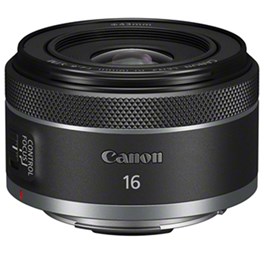
Aperture: f2.8 maximum Minimum Focus Distance: 13cm Weight: 165g Lens Construction: 9 elements in 7 groups Filter Compatibility: 43mm |
Pros:
Cons:
|
A welcome addition to the RF-mount lineup, the Canon RF 16mm f2.8 STM is a compact and lightweight lens offering an ultra-wide-angle field of view. Optimised for both photo and video applications, this 16mm f2.8 lens is incredibly versatile and well-suited to mid-level Canon mirrorless systems. It is further equipped with an advanced optical structure combined with a maximum f2.8 aperture and near-silent STM motor, resulting in super-smooth AF performance and all-round adaptability.
This allows for additional creative freedom when experimenting with depth of field, with this affordable Canon RF-mount lens lending itself to everything from landscape photography to high-end vlogging.
Optical quality is generally very good. If you were to turn off the automatic distortion correction functionality in EOS R cameras then you’d notice some pretty significant barrel distortion, but the solution is to simply not do that. It is worth being aware though that the low price of the lens means it skimps on some features like weather-sealing and built-in stabilisation.
|
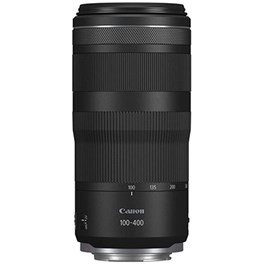
Focal Length: 100–400mm Aperture: f5.6–8 Stabilisation: 5.5-stop Optical IS Autofocus: Nano USM Weight: 635g |
Pros:
Cons:
|
Seeing a 100-400mm lens for a price as low as this is a very rare thing indeed, and it makes the RF systems one of the most compelling around for getting started with wildlife photography. The Canon RF 100-400mm f5.6-8 IS USM takes the classic popular wildlife-shooting telephoto focal range of 100-400mm and puts it in a chassis that costs less than half as much as these lenses normally do — and it still delivers some pretty brilliant image quality.
With impressive sharpness from edge to edge, this is a lens that will more than hold up to cropping or printing of your images. It also features 5.5-stop image stabilisation to help keep shots sharp when shooting handheld — useful when working at the outer edge of that focal length. It’s truly impressive all the features that have been packed into a lens that’s this affordable, with Canon even having squeezed in a Lens Control Ring for tactile settings adjustments.
Compromises have to be made, of course, and the variable maximum aperture does narrow considerably when you zoom in, getting to F8 at the outer edge of the zoom, which potentially compromises low-light shooting. It’s also worth noting that this lens is not weather-sealed and lacks a protective fluorine coating on the front element — so rain may have to stop play if your wildlife shoots are disrupted by poor weather.

Canon RF-S 14-30mm f4-6.3 IS STM PZ Lens
The RF-S 14-30mm f4-6.3 IS STM PZ is the first lens in Canon’s RF-S lineup to feature an internal Power Zoom system, offering 15 selectable speeds for electronically controlled focal length transitions. Its non-extending design maintains balance while zooming, maximising stability on gimbals and video rigs. Launched as Canon's R50 V kit lens, it covers a 14–30mm range with 5 stops of Optical IS, STM autofocus, and UD/PMo aspherical elements.
£379.00 View
|
Focal Length: 14–30mm Aperture: f4–6.3 Stabilisation: 4.5-stop Optical IS Zoom: Power Zoom Weight: 150g |
Pros:
Cons:
|
Released as a kit lens alongside the video-focused EOS R50 V, the Canon RF-S 14-30mm f4-6.3 IS STM PZ is a lens that is designed for vlogging from the ground up. While it will certainly take excellent photos, video is really the primary focus here, as is clearly reflected in its feature-set. For instance, you’ve got that Power Zoom mechanism with multiple speed settings, allowing you to create zoom transitions that feel smooth and purposeful, rather than jerky and awkward. Then there’s also the near-silent focusing, and the fact that the lens doesn’t extend when zooming in and out — good for balancing on a gimbal.
As the EOS R50 V is an APS-C camera, this lens is accordingly designed specifically for members of the EOS R family with these smaller sensors (hence the “RF-S” designation). This is great if you’re a committed user of these cameras, as lenses specifically designed for APS-C tend to balance much better than full-frame ones. However, it does mean that if you ever decide to upgrade to full-frame, you won’t be able to use this lens anymore. Could be worth a trade-in to knock down the price of your new camera!
|
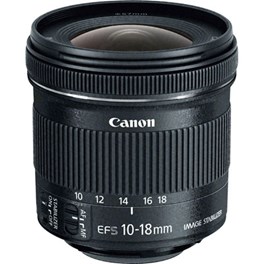
Aperture: f4.5-5.6 maximum Minimum Focus Distance: 22cm Weight: 240g Lens Construction: 14 elements in 11 groups Filter Compatibility: 67mm |
Pros:
Cons:
|
A fine choice for when you want to get as much into the frame as possible, this lightweight wide-angle lens provides an effective focal length of around 16-29mm on the APS-C bodies for which it’s designed, suiting it to landscapes, architecture and interiors among other subjects.
The fact that it’s designed specifically for APS-C bodies allows it to be relatively compact and light, and it benefits from the company’s STM technology for fast focusing and quiet operation during movie recording. Be aware though that it isn’t compatible with full-frame EF DSLRs, meaning it may not be worth it if you plan to upgrade in the near future.
The four-stop image stabilisation system lends a hand when capturing images handheld at slower shutter speeds, while a 22cm minimum focusing distance means you can get close up to subjects and still maintain a wide-angle field of view. If you don’t need a lens that’s also compatible with full-frame cameras, this wide zoom is well worth adding to your shortlist.
|
Aperture: f1.4 maximum Minimum Focus Distance: 45cm Weight: 290g Lens Construction: 7 elements in 6 groups Filter Compatibility: 58mm |
Pros:
Cons:
|
Canon's EF 50mm f1.4 USM lens is as compact and sturdy as the f1.8 version, but thanks to its larger maximum aperture it can create a shallower depth of field in images and is more capable in low light. Given that it's also available for a great price, it definitely merits inclusion here.
This is something of an oldie of a lens, dating back a couple of decades. You won’t find modern features like built-in stabilisation, but it’s a solid lens that handles the basics well. The ultrasonic motor (the 'USM' of the title) ensures fast focusing, with full-time manual focus override available if you prefer to make precise adjustments yourself. And indeed you may wish to do so, as it’s an older system and can sometimes be a little hit and miss, particularly when you’re working at the widest aperture settings.
Versatile and durable, at a size you can take everywhere, the 50mm f1.4 lens can swiftly become so reliable a companion that you wonder how you ever did without it.
|
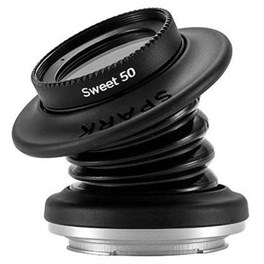
Aperture: f2.5 fixed Minimum Focus Distance: 33cm Weight: 150g Lens Construction: 2 elements in 1 group Filter Compatibility: 46mm |
Pros:
Cons:
|
For something a little different, and an escape from the ongoing wars of who's got the sharpest lens, why not try a Lensbaby optic? These lenses are designed with priority given to creative expression and character rather than technical perfection, and the Spark 2.0 is a shining example of the firm's trademark tilt-shift look.
By physically bending the lens, you can manually set the point of focus in an image, and surround it with stylised blur that gives your images a dreamlike effect. Bokeh is the name of the game, and the 12-blade aperture on the Lensbaby Spark 2.0 ensures that its images are immediately striking.
The unique squeeze-to-focus mechanism also makes the lens fun and tactile to use, and the results you get are always striking. The lens is compatible with full frame and APS-C cameras, so users of all Canon DSLRs can try out the distinctive experience of Lensbaby photography.

|
Focal Length: 60mm Aperture: f8 Focus: Manual focus Mount: Canon EF Construction: Plastic |
Pros:
Cons:
|
Yes, you read that price correctly. The Holga 60mm f8 HL-C-BK Lens costs less than a round of four beers at a London pub, and it’ll fit onto your Canon DSLR. It captures images that recall the look and feel of disposable camera holiday shots. It’s not a lens for supreme image quality or pixel-counting — it’s made to be a fun and highly affordable way to get a DSLR taking pictures, and it fulfils that brief perfectly.
If you ended up at this article because you found a DSLR in the attic, or if you have a child you’re attempting to teach about photography, then this lens is a perfect fit. The plastic construction means that it won’t stand up to heavy punishment, and scrutiny of images will reveal significant vignetting and softness — but again, what else would you expect for £19?
All things Canon


FAQs
How do I choose the right Canon lens for my camera?
The best Canon lens for you depends on your photography style, budget, and what you want to shoot. Whether you're after a wide-angle for landscapes, a telephoto for wildlife, or a prime lens for portraits, there’s a Canon lens to match. Just make sure it's compatible with your camera - EF and RF lenses work with full-frame models, while EF-S and RF-S are designed for APS-C cameras.
What’s the difference between EF and EF-S lenses?
EF lenses are designed for Canon’s full-frame and APS-C DSLR cameras, while EF-S lenses are built specifically for APS-C DSLRs. EF-S lenses tend to be smaller, lighter, and more budget-friendly, but they won’t work on full-frame Canon DSLRs. If you want flexibility across both sensor sizes, EF lenses are the way to go.
What is image stabilisation (IS)?
Image stabilisation (IS) helps reduce camera shake, keeping your shots sharp—especially in low light or when using slower shutter speeds. Canon offers in-lens stabilisation (IS), which is built into certain lenses, and in-body stabilisation (IBIS) in some of its cameras. If your lens has IS, it means you can shoot handheld with extra confidence.
Can I use Canon lenses on other camera brands?
Canon lenses are designed for Canon cameras, but you can use adapters to mount them on other brands. Just keep in mind that autofocus and electronic features may not work as smoothly - or at all - depending on the adapter and camera you’re using.
What does the “L” mean on Canon lenses?
Canon’s L-series lenses are its top-tier, professional-grade options. The “L” stands for luxury, meaning you get the best optical quality, premium build, weather sealing, and fast apertures. If you’re looking for top performance, these are the lenses to go for.
How do we decide?
Our in-house photography specialists, store staff, and industry partners work together to review our buying guides and advice articles. We also monitor emerging trends and listen closely to customer feedback, ensuring our recommendations stay current and relevant to what photographers and filmmakers are actually looking for.
By carefully curating the products we recommend, our guides are designed to offer clear, trustworthy advice that helps customers choose the right kit with confidence.
If you would like further advice, our contact centre team are here to help. You can also reach us via email or social media. And remember, if you purchase based on our recommendations, your order is covered by our full returns policy.




Sign up for our newsletter today!
- Subscribe for exclusive discounts and special offers
- Receive our monthly content roundups
- Get the latest news and know-how from our experts